
Read the last four digits of the DOT code on the sidewall. The first two are the week, the last two are the year. A tire stamped 2324 was made in the 23rd week of 2024, so it's about 2.4 years old in October 2026.
How old is too old depends on who you ask. Most tire makers say ten years is the limit, whatever the tread looks like. Some car makers say six. Nobody publishes a single rule that covers every car, so the honest answer is a range.
How to read the DOT code
The DOT code starts with the letters DOT and runs to a string of letters and numbers. On a new tire it's 8 to 13 characters long (Continental). You only need the end of it.
Discount Tire breaks a typical code into four parts:
- Plant code: which factory built the tire.
- Size code: a short code for the tire size.
- Maker's code: optional characters the brand uses for its own purposes.
- Date code: four digits for tires made since 2000. First two are the week, last two the year.
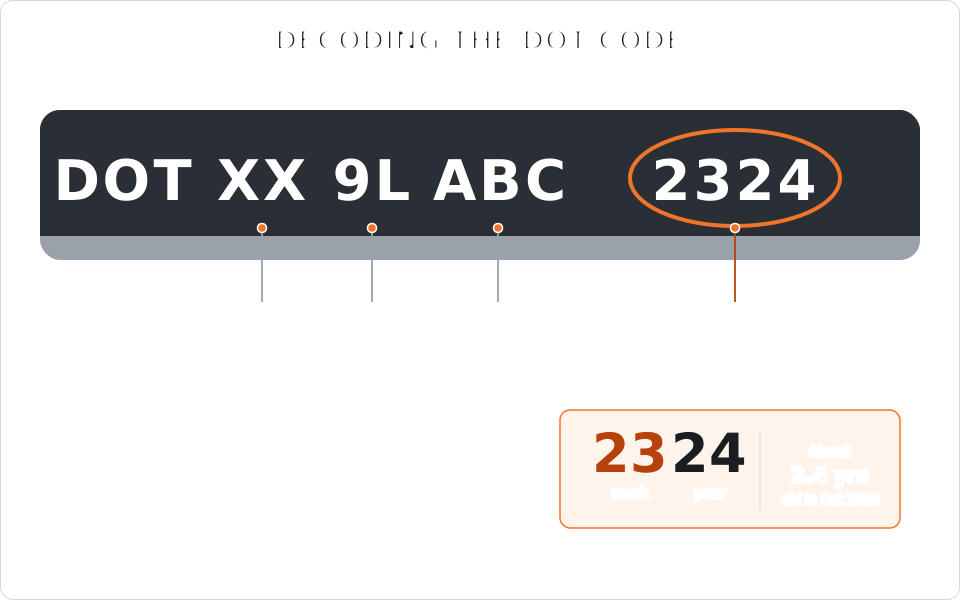
NHTSA gives its own example: a code ending 0308 means the third week of 2008.
If you can't find it
Look on the other side. The full code is often printed on one side only. The other side may show just DOT and the plant code (Discount Tire). NHTSA also says to check both sides.
If the full code faces inward on a fitted tire, turn the steering to full lock. Then use a flashlight and your phone camera.
Tires made before 2000 used a three-digit date. The first two digits are the week and the last one is the year within the decade (Discount Tire). Any tire like that is far past every limit below.
Quick age check
Date code | Made | Age in October 2026 |
|---|---|---|
2324 | Week 23, 2024 | About 2.4 years |
1023 | Week 10, 2023 | About 3.6 years |
4519 | Week 45, 2019 | About 6.9 years |
0116 | Week 1, 2016 | About 10.8 years |
0308 | Week 3, 2008 | About 18.7 years |
Ages counted from the start of the given week to 13 October 2026.
What each source says about tire age
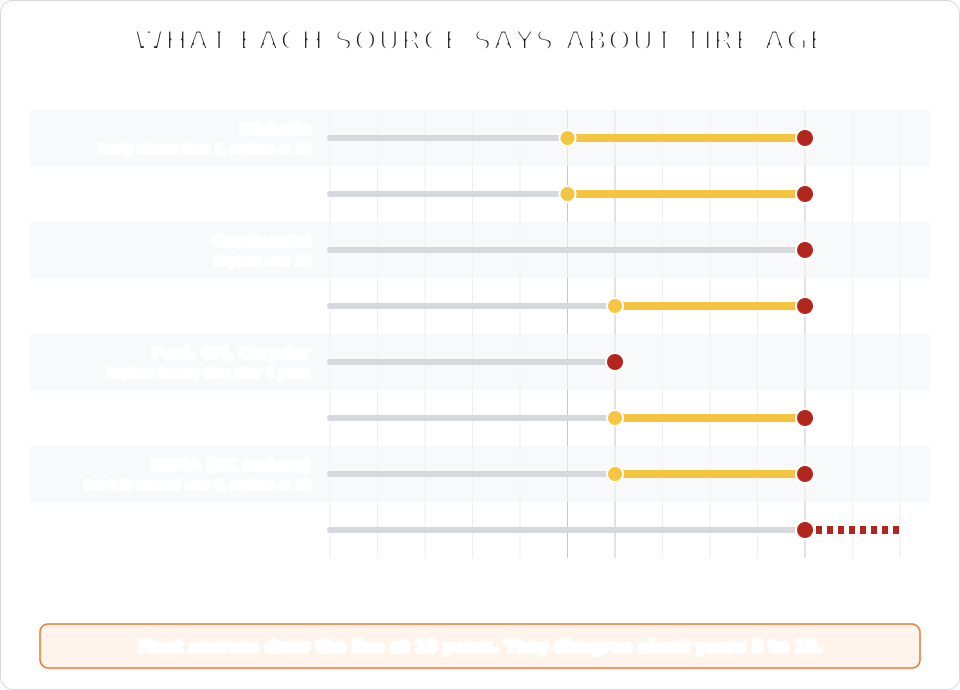
The sources agree on ten years as an outer limit. They differ on what happens between five and ten. Here's what each one actually says.
Source | Inspect | Replace | Notes |
|---|---|---|---|
At least yearly by a pro after 5 years of service | 10 years after manufacture | Includes the spare. Follow the car maker's advice for factory tires | |
After 5 years of use | More than 10 years after manufacture | Includes spares. Follow the owner's manual too | |
At least monthly, at any age | Over 10 years old | An unused tyre up to 5 years old can be sold as new | |
Not stated | No rule of its own | Notes some car and tire makers say 6 to 10 years | |
Chrysler, Ford, GM, per Tire Rack | Not stated | Factory tires after 6 years of service | Some European car makers' manuals say never use tires over 6 years old |
Not stated | Consider at 6 years | Won't service tires 10 years or older | |
BRMA (UK tyre makers), per Tire Rack | Not stated | 10 years from manufacture | Don't fit unused tyres over 6 years old |
Michelin's wording is the most specific. "After five years of service, tires should be thoroughly inspected at least once a year by a trained tire professional." It recommends "replacing tires ten years after their date of manufacture" even if they look fine (Michelin). Its older service bulletin adds that a car maker's shorter limit wins, "but not to exceed 10 years" (Michelin bulletin).
Bridgestone's 2005 service bulletin follows the Japanese tire makers' association (JATMA). It recommends that "all tires (including spare tires) that were manufactured more than ten (10) years previous be replaced" (Bridgestone Firestone).
Tire Rack's own view is that most street tires last six to ten years in service when stored and cared for properly (Tire Rack).
Note the wording. Some sources count from the date of manufacture and some from years in service. A tire that sat in a warehouse for two years has used up two of its ten either way, by Michelin's count.
What the law says
There's no legal age limit for car tires in the US or the UK. UK trade paper Tyrepress puts it plainly: "there is currently no legal age limit for car tyres" (Tyrepress).
The UK does ban old tyres on heavy vehicles. Since 1 February 2021, tyres over 10 years old can't be used on the front steered axles of lorries, buses and coaches. They're also banned on single wheels of minibuses with 9 to 16 passenger seats. The date code has to stay legible (Transport Operator).
That rule doesn't cover cars. It does show where regulators drew the line once they decided to draw one: ten years.
Low miles don't make an old tire safe
Age is a problem even on tires with deep tread. The same Tyrepress piece notes that sitting still and UV exposure can age rubber early, while tires in regular use can stay healthier (Tyrepress).
That matters most for weekend cars, classics, trailers and spares. Michelin says spares age on the same timeline "whether they've been used or not" (Michelin). If your spare is ten years old, it isn't a real backup. Our guide on how long you can drive on a spare tire covers the rest.
Tread still counts too. Michelin says a tire worn to 2/32 inch (1.6 mm) needs replacing, whatever its age.
Check the date before new tires go on
A "new" tire can already be a few years old. Continental says a properly stored, unused tyre up to five years old can be sold as new (Continental). The BRMA guidance quoted by Tire Rack says not to fit unused tyres over six years old.
So read the date code before the tires are mounted. If a shop offers you tires that are already three or four years old, ask for newer stock or a lower price. You're buying fewer years of life.
Old tires are also a common reason a shop says no. Discount Tire won't service tires that are ten or older. If you've got a slow leak on an old tire, our guide on driving with a nail in your tire covers your options.
What to do today
- Find the four-digit date code on all four tires and the spare. Use a flashlight and check the inside face.
- Work out each tire's age from the table above.
- If any tire is over five years old, have a tire shop inspect it, and repeat every year.
- Plan to replace any tire at ten years, sooner if your car's manual sets a shorter limit.
- When you buy, read the date code before the tires go on. Our guides on how to read a tire size and what new tires cost help with the rest.
Sources are linked in the text. Main references: Michelin, NHTSA, Bridgestone Firestone and Tire Rack.
Featured image: Old Tires by jaYmE del Rosario, CC BY 2.0. Source


No comments yet