
Not always, but you should at least get it checked. New tires don't knock the alignment out, because mounting them doesn't touch the steering or suspension. But if the alignment was already off, a fresh set will wear unevenly from day one.
The quick test is your old tires. If they wore evenly and the car tracks straight, take a free alignment check. If they wore on one edge, pay for the alignment before the new set rolls a mile. That's about $100 to $170 at a chain; our wheel alignment cost guide has the wider price picture.
Why tire shops push an alignment with new tires
They're not just upselling. Les Schwab says it recommends an alignment after new tires are installed because "This helps you get the most life from those tires." Pep Boys calls it "highly recommended after getting new tires," while admitting it isn't always required.
Tire Rack uses more careful wording. It says alignment "should be checked whenever new tires or suspension components are installed." Checked, not necessarily adjusted. That's the honest version of the advice.
The logic is simple. Uneven wear on the old tires is the alignment telling you something. Put new tires on without fixing it and you'll pay for the same wear twice.
What a small alignment error does to new tires
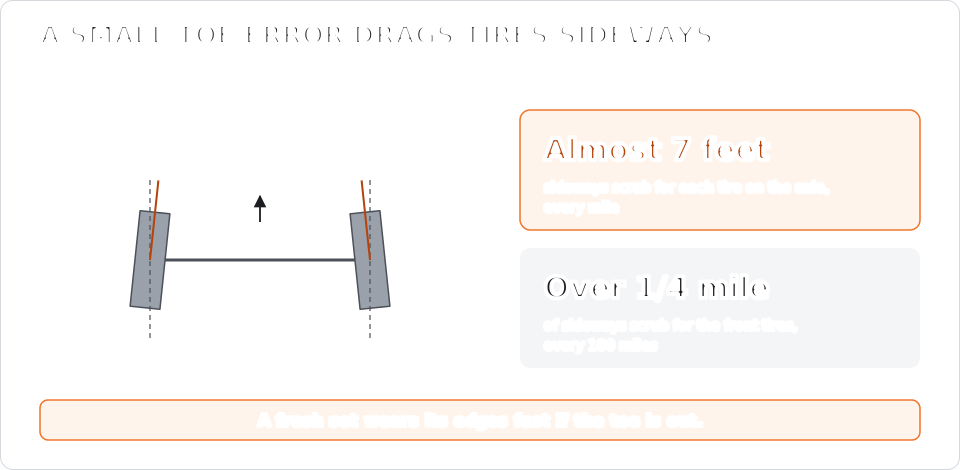
It drags them sideways every mile. Tire Rack calls toe "one of the most critical alignment settings relative to tire wear." Its example: with just 1/16 inch of toe error, each tire on that axle "will scrub almost seven feet sideways every mile."
That adds up. Tire Rack says the front tires scrub over a quarter mile sideways every 100 miles. Too much negative camber does something similar to the inner edge.
Tire Rack's view is that regular alignments "will usually save you as much in tire wear as they cost." With new tires on the car, that's when the saving is biggest.
When you need one, and when a check will do
Pay for the alignment if any of these apply. Otherwise a free check is enough.
- The old tires wore on the inside or outside edge, or the tread feels feathered when you run a hand across it.
- The car pulls to one side, or the steering wheel sits off-center on a straight road. Les Schwab and Pep Boys both list these signs.
- You've hit a curb or deep pothole since the last alignment. Les Schwab says a sharp impact is reason to check sooner.
- You've had steering or suspension parts replaced. Tire Rack says to check alignment after new suspension components too.
- The car has been lifted or lowered. Discount Tire says ride-height changes call for an alignment check.
Check tire pressures before you blame alignment. A soft tire can pull on its own, as our guide on driving with low tire pressure explains.
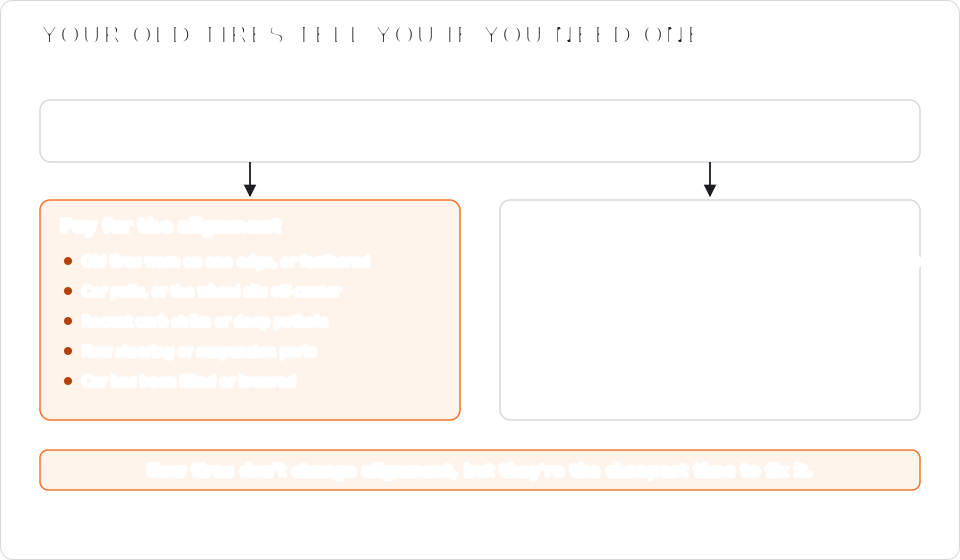
If none of these apply, ask for the free check. Les Schwab says its visual alignment checks "are always free," and Pep Boys lists a "Free alignment check and printout." Pay for the adjustment only if the readings come back out of spec.
What tire warranties say about alignment
Treadwear warranties don't pay for wear caused by bad alignment. That's the main money reason to sort it out when the tires go on. In the four warranty booklets below, we found no rule that you need an alignment receipt at installation. But each one excludes misalignment wear or makes alignment your job.
Warranty | Rotation rule | What it says about alignment | Records you need |
|---|---|---|---|
Michelin (Rev. 05/22) | Every 6,000 to 8,000 miles, or the carmaker's interval if shorter | Excludes wear caused by wheel misalignment | Signed rotation record, installation form, original invoice |
Goodyear (printed 5/20/25) | Carmaker's schedule, at most every 6,000 miles | Excludes irregular wear from the vehicle's mechanical condition | Original invoice showing mileage and date installed |
Regular rotation, per the warranty manual | "It is also your obligation to maintain proper wheel alignment" | Proof showing date, mileage and servicing location | |
Kumho (2026 brochure) | At least every 5,000 to 7,500 miles, or per the owner's manual | Excludes misalignment wear, defined as 2/32 inch or more tread difference across one tire | Proof of purchase |
Kumho's definition is the useful one. If the tread depth differs by 2/32 inch or more across the same tire, Kumho counts it as misalignment wear, which its warranty doesn't cover. The Bridgestone and Firestone terms are the tire maker's limited warranty, as posted on Firestone Complete Auto Care's site. Michelin goes further on rotation: miss it and the treadwear warranty is void.
Pep Boys puts it plainly: abnormal wear from poor alignment "is often not covered under tire warranties or road hazard protection plans." An alignment printout dated the day the tires went on is cheap evidence that the car was in spec from the start. File it with the tire invoice.
Which alignment, and what it costs
Most cars need a four-wheel alignment, and trucks with a solid rear axle need a thrust angle alignment. Our guide to front-end vs four-wheel alignment explains which you have. The prices below are as listed when we checked in October 2026.
Shop | What's listed | Price | Source |
|---|---|---|---|
Jiffy Lube | Two-wheel | $50 to $75 | |
Jiffy Lube | Four-wheel | $100 to $168 | Jiffy Lube |
Pep Boys | 30-day alignment package | From $109.99 with coupon ($20-off coupon expires Oct 31, 2026) | |
Les Schwab | Thrust angle | From $119.99 | Les Schwab |
Les Schwab | Four-wheel | From $134.99 | Les Schwab |
RepairPal | Shop estimate | $186 to $273 | RepairPal, updated Sep 3, 2026 |
AAA | One replacement tire | $150 to $400 or more |
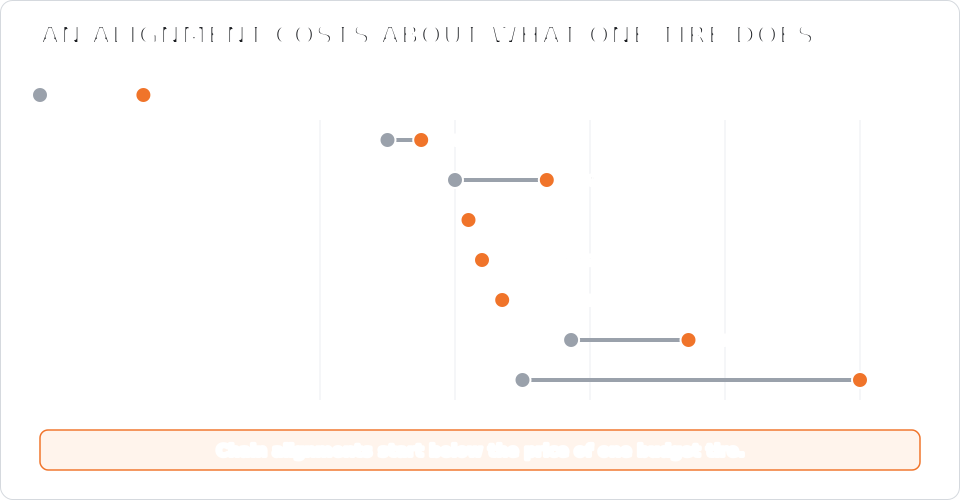
A few things push the price up. Les Schwab says its four-wheel price can be higher depending on the vehicle. The fine print on Firestone's lifetime alignment offer (valid Oct 1 to Oct 31, 2026) says an extra $20 may apply to cars with driver-assist (ADAS) systems, and more may apply with stability control. It also adds a shop supply fee of 8 to 10% of labor, capped at $40, on invoices over $35. Worn tie-rod ends or bushings have to be replaced first, or the alignment won't hold.
If you're buying at Discount Tire, ask before you book. It says not all of its stores offer alignment.
What to do today
- Before the old tires come off, look at the tread. Note any edge wear or feathering, or ask the installer to show you.
- Check that the car drives straight with the steering wheel centered, on correctly inflated tires.
- If the old tires wore evenly and the car tracks straight, ask for a free alignment check and keep the printout.
- If you saw edge wear, a pull or an off-center wheel, pay for a four-wheel or thrust angle alignment the same day the tires go on.
- File the alignment printout with the tire invoice and keep rotating on the warranty's schedule.
Common questions
Do you need an alignment after getting new tires?
Not automatically. New tires don't change the alignment. But Les Schwab recommends one with every new set, and Tire Rack says it should at least be checked. If your old tires wore unevenly, it's needed.
Does a tire warranty require an alignment?
Not as a receipt at installation, in the four warranties above. But Michelin, Goodyear and Kumho exclude wear caused by misalignment or the vehicle's condition, and Bridgestone makes alignment your obligation. A dated printout helps if you ever claim.
Do I need an alignment if I only replace two tires?
The same test applies. If the old pair wore evenly and the car tracks straight, a free check is enough. If they wore on one edge, align the car, or the new pair will wear the same way.
How much is an alignment with new tires?
Posted chain prices start at about $100 to $135 for a four-wheel or thrust job in October 2026. RepairPal's shop estimate is $186 to $273. Some chains also sell lifetime packages; we ran the numbers in is a lifetime alignment worth it.
Sources
Sources are linked in the text. Main references: Tire Rack, Les Schwab, Michelin warranty and RepairPal.
Featured image: Faulstich Wheel Alignment by pasa47, CC BY 2.0. Source


No comments yet