
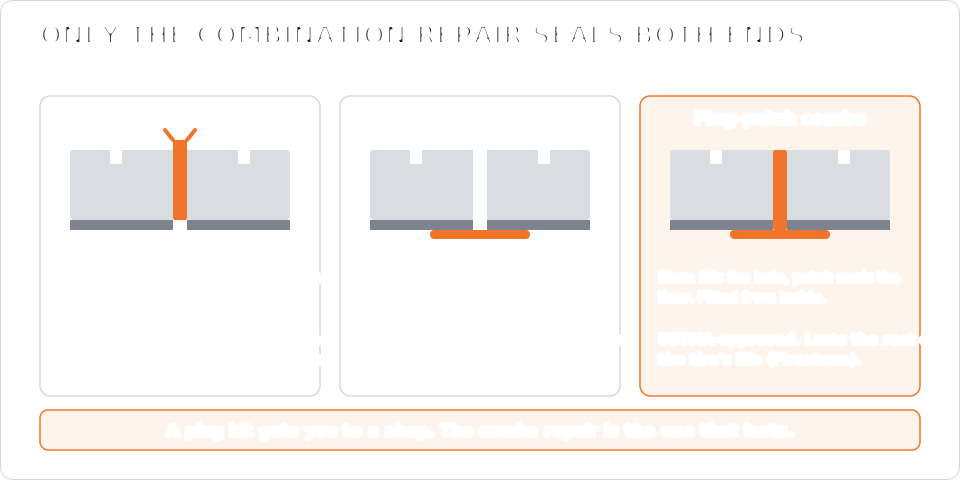
Neither one on its own. The safe repair is both together: a rubber stem that fills the hole and a patch that seals the inside, fitted with the tire off the wheel. That combination lasts the rest of the tire's life. A plug pushed in from outside isn't an accepted repair at all, only an emergency fix to get you to a shop.
A proper repair is free at Discount Tire and usually $20 to $75 elsewhere. A new tire runs $150 to $400 or more. If you're still driving on the nail, our guide to how long you can drive with a nail in your tire covers what's safe until then.
Plug vs patch vs combo, side by side
The industry has already picked the winner. The U.S. Tire Manufacturers Association's puncture repair procedures say "A repair using a plug only or a patch only is NOT ACCEPTABLE." Each one does half the job. The same chart says never to repair a tire from the outside or while it's still on the wheel.
A plug is a sticky rubber cord pushed into the hole from outside. It's quick, five minutes at most according to Mechanic Base, and the wheel stays on the car. But nobody looks inside the tire. AAA calls it "a temporary, emergency fix."
A patch is glued over the hole from inside. It seals the liner, but the channel through the tread stays open. AAA warns that moisture can get in that way and rust the steel belts.
The combination does both jobs. Firestone calls it the "industry-recommended repair method" and says it can last the rest of the tire's life. Les Schwab says the same and repairs no other way.
Repair | How it's fitted | Industry verdict | How long it lasts | Typical cost |
|---|---|---|---|---|
Plug only | From outside, wheel on the car | Not acceptable (USTMA) | A day to several months (Firestone) | Under $10 as DIY (Firestone) |
Patch only | From inside, tire off the wheel | Not acceptable (USTMA) | Liner sealed, but water can reach the belts (AAA) | A combo "may cost slightly more" (Firestone) |
Plug-patch combo | From inside, tire off the wheel | The approved method (USTMA) | Rest of the tire's life (Firestone) | Free to about $75 |
Is a plug safe to drive on?
Only as a slow, short emergency measure, and only if the tire holds air. USTMA doesn't count an outside plug as a repair. AAA treats it as a temporary fix: stay under 50 mph and drive only as far as a repair shop.
The bigger risk is what you can't see. AAA says that from outside it's impossible to know whether the puncture caused hidden damage inside. Only taking the tire off the wheel shows that.
How long a plug lasts is anyone's guess. Firestone's answer is that it "might hold for a day, or it might last several months." Too wide a range to bet a highway trip on.
A DIY plug can also cost you the tire. USTMA says a tire with an existing improper repair "must be scrapped," and it rates a plug alone as not acceptable. A shop that follows those rules strictly may refuse to patch over your plug, so fit the spare if you have one.
If the tire is losing air fast or has gone flat, don't drive on it. AAA warns that driving on a flat can destroy the sidewall's internal structure even when nothing shows outside. Fit the spare instead. Our guide to how long you can drive on a spare tire covers the limits.
When a tire can't be repaired at all
Size and location decide it, not how small the nail looks. Under USTMA's rules, the tire gets replaced if:
- the hole is bigger than 1/4 inch (6 mm) across,
- the damage is in the shoulder or sidewall, or runs at an angle into the shoulder (if there's any doubt, USTMA says the tire comes out of service),
- the new repair would overlap an old one, or
- it already has an improper repair. USTMA says that tire "must be scrapped."
Spacing between repairs is the tire maker's call. USTMA's only rule is that repairs can't overlap. Tire Rack's summary of maker policies shows how much they differ:
Tire maker | Repairs allowed | Minimum spacing |
|---|---|---|
Bridgestone, Firestone | Up to 2 | 16 inches apart |
Michelin, BFGoodrich, Uniroyal | Up to 3 | 90 degrees apart |
Kumho | Up to 2 | 180 degrees apart |
Continental, Cooper, Hankook, Yokohama and others | No count listed | Repairs can't overlap |
AAA and Firestone use 16 inches as a general rule, the safe assumption if you don't know your maker's policy. AAA also says a tire worn to the 2/32 inch legal minimum gets replaced, not fixed, and Michelin agrees for tires at the legal wear limit.

This is why you leave the nail in and look at where it sits first. A nail in the tread is a $0 to $75 problem. One in the shoulder means a new tire.
Run-flat tires follow the tire maker's rules
Some run-flats can be repaired and some can't. USTMA leaves it to each manufacturer, and their policies differ a lot. Tire Rack's run-flat repair table, checked October 2026, lists them:
Brand | Run-flat repair | Condition |
|---|---|---|
Bridgestone, Firestone | Permitted | Only if 15 psi was maintained |
Michelin, BFGoodrich | Permitted | One repair maximum |
Goodyear, Dunlop | Permitted | One repair maximum on H speed rating and up |
Hankook, Kumho | Permitted | None listed |
Continental | Does not recommend | Road hazard program instead |
Pirelli | Not endorsed | Road hazard program: free in year one or the first 2/32 in of wear, then prorated |
Yokohama | Not repairable | Not to be repaired if run-flat |
The catch is the driven-flat part. A run-flat is built to keep rolling with no air, so you may not notice the puncture until the warning light comes on. Tire Rack won't repair any run-flat that was driven severely underinflated or at zero pressure, because the internal damage can be invisible. It says to drive at the slowest safe speed, below 50 mph, to the nearest shop.
Continental adds a sting. Tire Rack reports that a repair to one of its tires "invalidates all other manufacturer's warranties." Policies change, so confirm with the tire maker or your dealer before paying for a run-flat repair.
What a repair does to your speed rating
On many brands, a repaired tire loses its speed rating. Tire Rack's flat repair and speed rating summary says a tire that loses its rating "should be treated as a non-speed rated tire driven no faster than 85 mph."
- Rating voided after repair: Bridgestone, Cooper, Falken, Firestone, Hankook, Kumho, Sumitomo and Yokohama.
- Rating kept within repair limits: BFGoodrich, Continental, General, Michelin and Uniroyal. Tire Rack notes that a repair on a Continental, General or Uniroyal tire voids its materials, workmanship and treadwear warranties.
- One repair only: Goodyear and Dunlop keep the rating on H-rated tires and up after a single repair.
For most daily drivers this changes nothing. It matters on a W- or Y-rated performance tire. The letter after the load index on the sidewall is the speed rating, as our guide to reading a tire size explains.
What each repair costs
A proper repair is cheap, and often free. Discount Tire fixes any USTMA-repairable tire at no charge, "even if you didn't buy your tires from us."
Option | Price | Source |
|---|---|---|
Discount Tire, any repairable tire | Free | Discount Tire, October 2026 |
Les Schwab, tires bought there | Free | Les Schwab, October 2026 |
Shop repair | $25 to $75 | AAA, checked October 2026 |
Shop patch | $30 to $60 | Mechanic Base, updated 2023 |
Average tire repair, 2023 | $20 to $50 | |
DIY plug kit | Under $10 | Firestone |
Complete DIY plug toolkit | $50 to $100 | AAA |
Replacement tire | $150 to $400 or more | AAA |
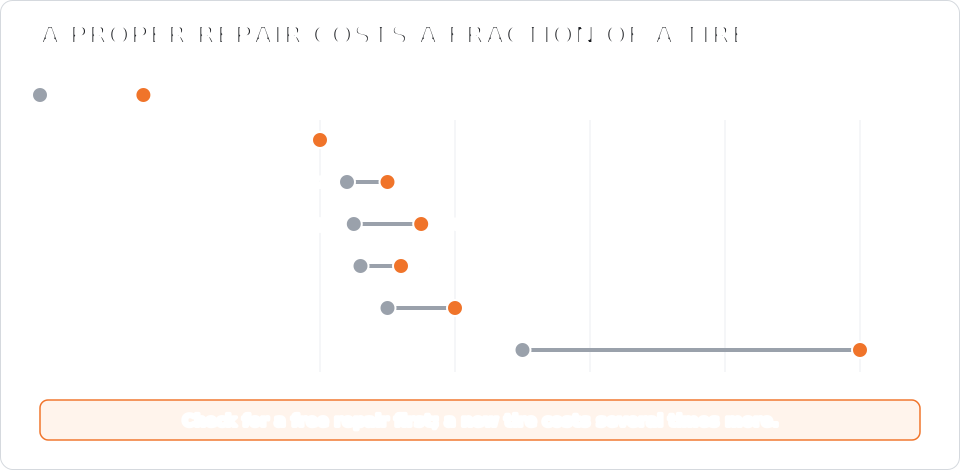
Labor rate and time move the shop price. Mechanic Base puts a patch at 15 to 20 minutes, against five for a plug. A plug kit saves little when Discount Tire repairs for free, and it's a last resort for when there's no spare.
What to do today
- Leave the nail in and check the pressure. If it's dropping fast or the tire is flat, fit the spare and don't drive on it.
- Look at where the hole is. Tread is usually repairable. Shoulder or sidewall means a new tire.
- Use the spare rather than a DIY plug. If you have no spare and must plug it, stay under 50 mph and drive straight to a shop.
- Ask for a plug-patch combination with the tire taken off the wheel. If a shop offers to plug it on the car, go elsewhere.
- On a run-flat or a W- or Y-rated tire, check your brand's policy in the tables above before you pay.
Common questions
Is a tire plug or patch safer?
A plug-patch combination is safer than either one. USTMA rates a plug only or a patch only as not acceptable. At the roadside the spare is the safer choice. A plug is a last resort for a slow drive, under 50 mph, straight to a shop.
How long does a tire plug last?
Nobody can promise a number. Firestone says a plug might hold a day or several months, and AAA says its lifespan "is never certain." A plug-patch combination lasts the rest of the tire's life.
Can you patch a run-flat tire?
It depends on the brand. Bridgestone, Michelin and Goodyear allow it with limits, Continental and Pirelli don't endorse it, and Yokohama says no. Tire Rack won't repair any run-flat that was driven at zero pressure.
How much does it cost to plug or patch a tire?
A plug kit is under $10. A proper plug-patch repair is free at Discount Tire and about $20 to $75 at other shops, according to AAA, Mechanic Base and SlashGear.
Sources
Sources are linked in the text. Main references: USTMA, AAA, Tire Rack and Firestone.
Featured image: Nail in Tire by vxla, CC BY 2.0. Source


No comments yet