
A tire size reads left to right, and each part means one thing. Take a 225/45R17 94W XL tire. 225 is the width in millimeters. 45 is the sidewall height as a percentage of that width. R means radial, and 17 is the wheel size in inches.
The last part is two codes. The 94 is the load index, which works out to 1,477 lb per tire. The W is the speed rating, which means 168 mph. XL means extra load.
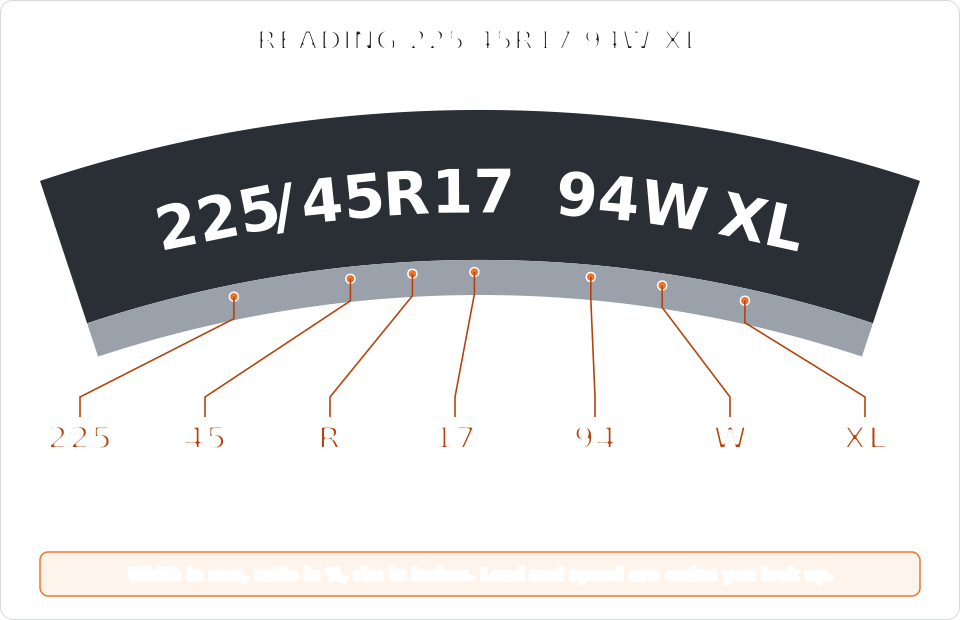
That's a real size. Kal Tire lists the Nitto NT05 as 225/45R17 with load index 94, speed rating W and load range XL.
Where to find your tire size
Look at the sidewall of the tire you have now, or at the label on the driver's door edge or post. NHTSA says to check that Tire and Loading Information Label, or the owner's manual, for the size your car should run.
Use the door label if you've bought a used car. The tires on it may not be the size the maker fitted.
Width, aspect ratio and rim size
The first three numbers describe the tire's shape. Tire Rack breaks them down like this:
- 225 is the section width. That's how wide the tire is, in millimeters. 225 mm is 8.86 inches, which is the section width Kal Tire lists for this tire.
- 45 is the aspect ratio. The sidewall is 45% as tall as the tire is wide. A lower number means a shorter, stiffer-looking sidewall.
- R is the construction. R means radial, which is what nearly every car tire is now. Tire Rack also lists D for bias-ply and RF for a self-supporting run-flat.
- 17 is the rim diameter. The tire fits a 17-inch wheel, measured in inches even though the width is in millimeters.
A letter in front of the size tells you who the tire was designed for. P means passenger car (P-metric). LT means light truck. No letter at all, like our example, is a Euro-metric size, a system that started in Europe (Tire Rack).
Some sizes have ZR instead of R, as in 225/50ZR16. The Z marks a tire built for more than 149 mph. The letter in the service description gives the real limit (Tire Rack).
How to work out the overall diameter
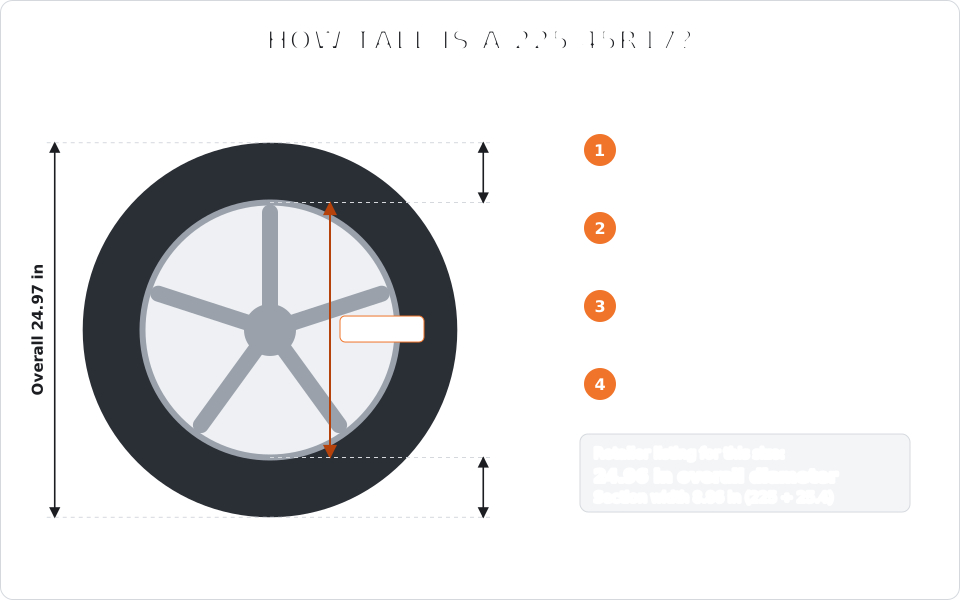
Multiply the width by the aspect ratio to get one sidewall's height. Double it, convert to inches and add the rim. That's the method eBay Motors gives.
For 225/45R17:
- One sidewall: 225 mm × 45% = 101.25 mm.
- Both sidewalls: 101.25 × 2 = 202.5 mm.
- In inches: 202.5 ÷ 25.4 = 7.97 in.
- Add the rim: 7.97 + 17 = 24.97 inches tall.
Kal Tire lists the NT05 in this size at 24.96 inches. Real tires differ by a few hundredths depending on the model and the rim width.
Diameter matters when you change sizes. Tire Rack says to keep the same overall diameter when you change tire and wheel sizes. A big change can throw off the speedometer, ABS, traction control and stability control (Tire Rack).
Here's how some common swaps compare against a stock 225/45R17:
Size | Overall diameter | Change vs 225/45R17 | Real speed when the speedometer reads 60 mph |
|---|---|---|---|
225/45R17 (stock) | 24.97 in | none | 60.0 mph |
235/40R18 (plus one) | 25.40 in | +1.7% | 61.0 mph |
225/50R17 | 25.86 in | +3.6% | 62.1 mph |
245/40R17 | 24.72 in | −1.0% | 59.4 mph |
215/45R17 | 24.62 in | −1.4% | 59.1 mph |
Calculated with the formula above. A taller tire covers more ground per turn, so you go faster than the speedometer shows.
The tire size calculator does this for any two sizes. If you're also changing wheels, check offset with the wheel offset calculator and our guide to wheel offset and backspacing.
Load index: how much weight each tire carries
The load index is a code for the most weight one tire can carry at its maximum pressure. It isn't pounds. You look it up (Pirelli).
Our 94 means 1,477 lb, or 670 kg, per tire (Tire Rack). Four of them can carry 5,908 lb. These are the values you'll see on most cars:
Load index | Max load per tire | Max load per tire |
|---|---|---|
87 | 1,201 lb | 545 kg |
89 | 1,279 lb | 580 kg |
91 | 1,356 lb | 615 kg |
92 | 1,389 lb | 630 kg |
93 | 1,433 lb | 650 kg |
94 | 1,477 lb | 670 kg |
95 | 1,521 lb | 690 kg |
96 | 1,565 lb | 710 kg |
97 | 1,609 lb | 730 kg |
98 | 1,653 lb | 750 kg |
99 | 1,709 lb | 775 kg |
100 | 1,764 lb | 800 kg |
102 | 1,874 lb | 850 kg |
104 | 1,984 lb | 900 kg |
Values from Tire Rack's load index chart.
Never fit a tire with a lower load index than the door label calls for. Higher is fine.
LT tires show two numbers, such as 104/101. The first is for a single rear wheel and the second for dual rear wheels (Tire Rack).
What XL means
XL, or extra load, means a stronger tire that can run more pressure. It only carries more weight at that higher pressure. Tire Rack is blunt about it. An extra load tire "is not rated to carry any more load than a standard load tire when both are inflated to the same pressure" (Tire Rack).
Euro-metric standard load tires reach their maximum load at 36 psi. XL versions reach theirs at 42 psi. Keep running the pressure on your door label unless your tire shop tells you otherwise.
Speed rating: the letter after the load index
The speed rating is the top speed the tire is built for, as a letter code. Ratings only hold for a tire that hasn't been damaged, altered or driven underinflated (Tire Rack).
Rating | Max speed | Max speed |
|---|---|---|
S | 112 mph | 180 km/h |
T | 118 mph | 190 km/h |
U | 124 mph | 200 km/h |
H | 130 mph | 210 km/h |
V | 149 mph | 240 km/h |
W | 168 mph | 270 km/h |
Y | 186 mph | 300 km/h |
(Y) | over 186 mph | over 300 km/h |
Values from Tire Rack. A Y in brackets, as in (99Y), means the tire was tested above 186 mph.
The letters aren't in alphabetical order. H sits between U and V, so an H tire isn't slower than a T. Match or beat the rating your car came with.
The other markings on the sidewall
The size isn't the only code on the tire. Two more matter when you buy:
- DOT code. The last four digits are the week and year the tire was made (NHTSA). Our guide to the DOT date code explains how old is too old.
- UTQG grades. Most passenger tires sold in the US carry a treadwear number, a traction grade and a temperature grade. Traction runs AA, A, B or C, and temperature A, B or C. The treadwear number is relative to a control tire rated 100 (NHTSA). Kal Tire lists the NT05 at 200AAA, which our piece on 200-treadwear tires covers.
The pressure on the sidewall is the tire's maximum, not what you should run. NHTSA says to use the vehicle maker's figure. Running low has its own risks, covered in is it bad to drive with low tire pressure.
What to do today
- Read the size off the driver's door label and write it down with the load index and speed rating.
- Check that the tires on the car match it, on all four corners.
- If you're shopping for a different size, run old and new through the tire size calculator and stay close on diameter.
- Confirm the new tire's load index and speed rating are equal to or higher than the label.
- Check the DOT date before the tires go on. Then see how much new tires cost in your size.
Sources are linked in the text. Main references: Tire Rack sidewall guide, Tire Rack load index chart, Tire Rack speed ratings and NHTSA.
Featured image: Tire Size 15 by cogdogblog (CC0). Source


No comments yet