
Wheel offset is the distance from the wheel's mounting face to the middle of the wheel, measured in millimeters. The mounting face is the flat part that bolts to the hub. It's marked on the wheel as ET. On an ET45 wheel, that face sits 45 mm toward the outside of the car from the wheel's center.
That one number decides where the wheel sits in the wheel well. Higher offset tucks the wheel in. Lower offset pushes it out.
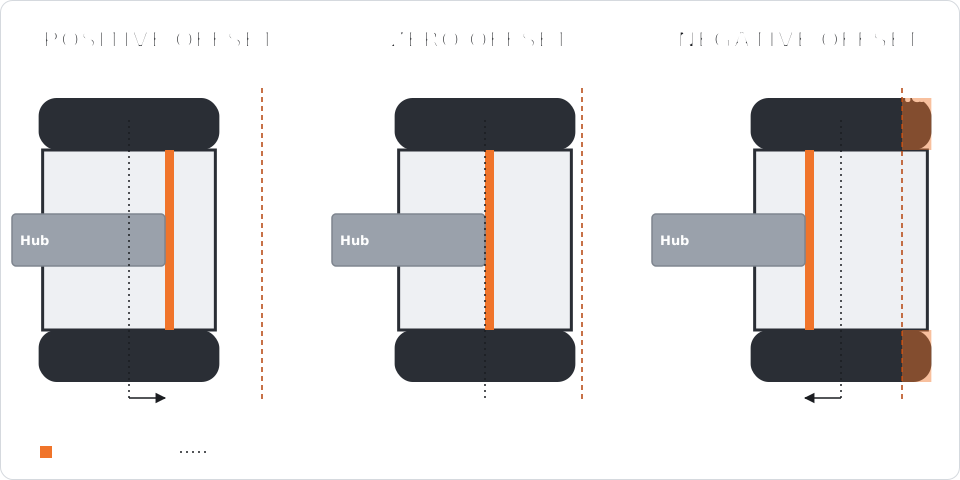
What ET means
ET is just the offset in millimeters. It's short for Einpresstiefe, German for "insertion depth" (Konig). You'll see it written as ET45, +45 or 45 mm. They all mean the same thing.
There are three cases, and Tire Rack defines them like this:
- Positive offset: the mounting face sits toward the outside of the car from the wheel's center. The wheel tucks in toward the brakes and suspension. Almost every modern car uses it.
- Zero offset: the mounting face sits right on the wheel's center.
- Negative offset: the mounting face sits toward the inside of the car from the wheel's center. The wheel sticks out. Think deep-dish wheels and lifted trucks.
Positive is normal. A stock MK7 GTI runs +49 or +51 depending on the wheel, a 2022+ WRX runs +55 and a 2024 Tacoma runs +60 (TireWheelGuide, FastWRX).
Where to find your offset
Check the wheel itself. Offset is usually stamped or engraved into it (Konig). You'll often find it on the back of a spoke or inside the rim, next to the size. For example, "7.5J x 17 ET51" means 7.5 inches wide, 17-inch diameter, +51 offset.
Don't count on the door-jamb sticker. It usually lists tire sizes, not offset. If the stamp is worn off, measure the backspacing and convert it with the formula below.
Offset vs backspacing
Backspacing is the same idea, measured differently. It's the distance from the mounting face to the inner lip of the wheel, in inches (Discount Tire). It's always a positive number (Wheel-Size.com). Truck and Jeep owners tend to talk in backspacing. Car owners talk in offset.
The catch is width. A wheel sold as "8 inches" is measured where the tire's bead sits, not edge to edge. Edge to edge it's about an inch wider, because each rim flange, the raised lip at the edge, adds roughly half an inch (TireSize.com, TireWheelGuide). The conversion has to use that real width.
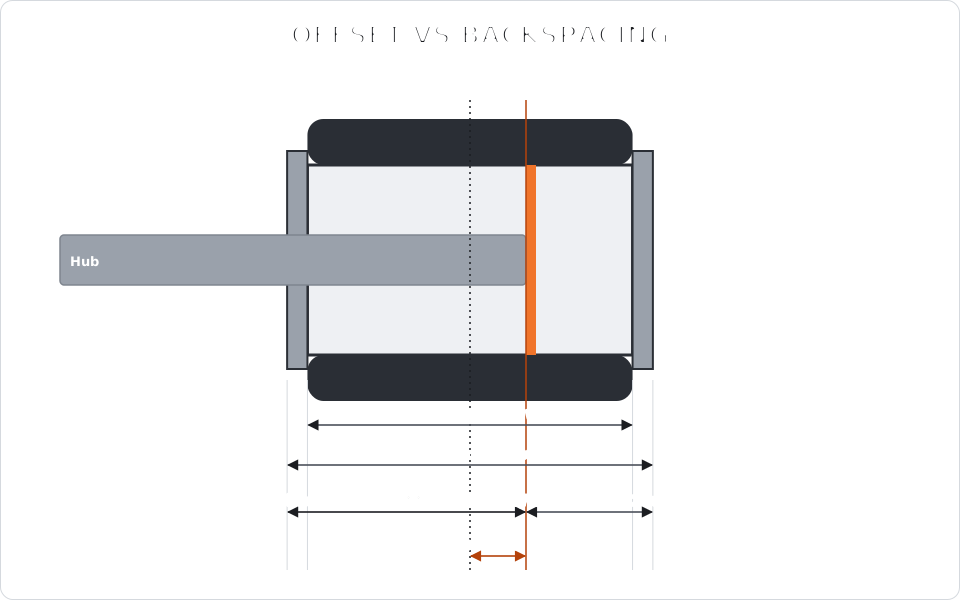
Wheel-Size.com gives the formula:
- Backspacing (inches) = (width + 1) ÷ 2 + offset ÷ 25.4
- Offset (mm) = (backspacing − (width + 1) ÷ 2) × 25.4
Here's a 17x7.5 ET51 wheel, one of the factory sizes listed for the MK7 GTI (ThreePiece). US cars more often came on 18-inch wheels (TireWheelGuide). That's 17 inches across, 7.5 inches wide and +51 offset. Half the real width is (7.5 + 1) ÷ 2 = 4.25 inches. The offset is 51 ÷ 25.4 = 2.01 inches. Add them and you get about 6.26 inches of backspacing.
The formula matches published numbers. Ford Performance lists 172 mm of backspacing for its 19x9 ET45 Mustang GT wheel, and 186 mm for the 19x9.5 ET52.5 rear. The formula gives 172 mm and 185.9 mm.
Width | ET +50 | ET +35 | ET +20 | ET 0 | ET −12 |
|---|---|---|---|---|---|
7 in | 5.97 in | 5.38 in | 4.79 in | 4.00 in | 3.53 in |
8 in | 6.47 in | 5.88 in | 5.29 in | 4.50 in | 4.03 in |
9 in | 6.97 in | 6.38 in | 5.79 in | 5.00 in | 4.53 in |
10 in | 7.47 in | 6.88 in | 6.29 in | 5.50 in | 5.03 in |
Backspacing worked out with the Wheel-Size.com formula. Real wheels can differ by a millimeter or two.
How to calculate fitment
Compare the old wheel and the new one at both edges. Two rules do all the work (TireWheelGuide):
- Extra width splits evenly. One more inch is 25.4 mm, so each side, inside and outside, gets 12.7 mm.
- Offset moves the whole wheel. Each millimeter less offset moves both edges 1 mm outward. Each millimeter more moves them in.
Put together:
- How far the outer lip moves out (poke) = width change in inches × 12.7 + (old offset − new offset)
- How far the inner lip moves in, toward the suspension = width change in inches × 12.7 − (old offset − new offset)
A positive answer means the lip moves that way. A negative answer means it moves the other way, so on the inside you gain room.
Take that 17x7.5 ET51 GTI wheel and swap it for an 18x8.5 ET45. Only the width counts here, 7.5 to 8.5 inches. The bigger diameter doesn't move the edges sideways.
The extra inch adds 12.7 mm per side. The offset drops 6 mm, so the whole wheel also shifts 6 mm out. On the outside the two add up: 12.7 + 6 = 18.7 mm farther out. On the inside they partly cancel: 12.7 − 6 = 6.7 mm closer to the strut.
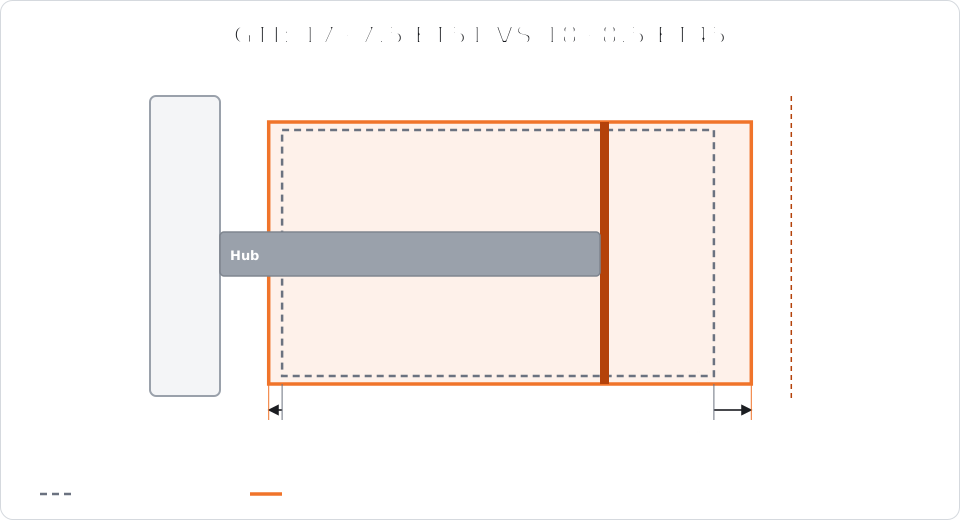
Car | Stock wheel | New wheel | Outer lip | Inner lip |
|---|---|---|---|---|
VW GTI MK7 | 17x7.5 ET51 | 18x8.5 ET45 | 18.7 mm farther out | 6.7 mm closer to suspension |
Mazda MX-5 ND | 17x7 ET45 | 17x8 ET35 | 22.7 mm farther out | 2.7 mm closer to suspension |
Jeep Wrangler JL | 17x7.5 ET44.4 | 17x9 ET−12 | 75.5 mm (about 3 in) farther out | 37.4 mm farther from suspension |
Any car | 18x8.5 ET45 | same wheel + 10 mm spacer | 10 mm farther out | 10 mm farther from suspension |
That Jeep wheel also shows where a common forum answer comes from. A 17x9 −12 wheel has about 4.53 inches of backspacing. That's close to the 4.5 inches JK owners often pick for 35-inch tires (JK-Forum).
The tire adds its own width on top. The first number in a tire size is its width in millimeters. Going from a 225 to a 245 adds about 10 mm on each side, though the exact width depends on the rim.
You can also skip the math. Our wheel offset calculator does both edges and the backspacing for you. Will They Fit and the TireSize.com offset calculator both compare an old and new setup. They show poke and inner clearance.
How much offset change is safe
Judge it by how far each edge of the wheel moves, not by the offset number. TireWheelGuide's rule of thumb works like a traffic light. If both edges sit within about 5 mm of the old wheel, it usually fits like stock. Up to 15 mm can work once you've checked clearance. Beyond that it usually rubs the suspension or the fender.
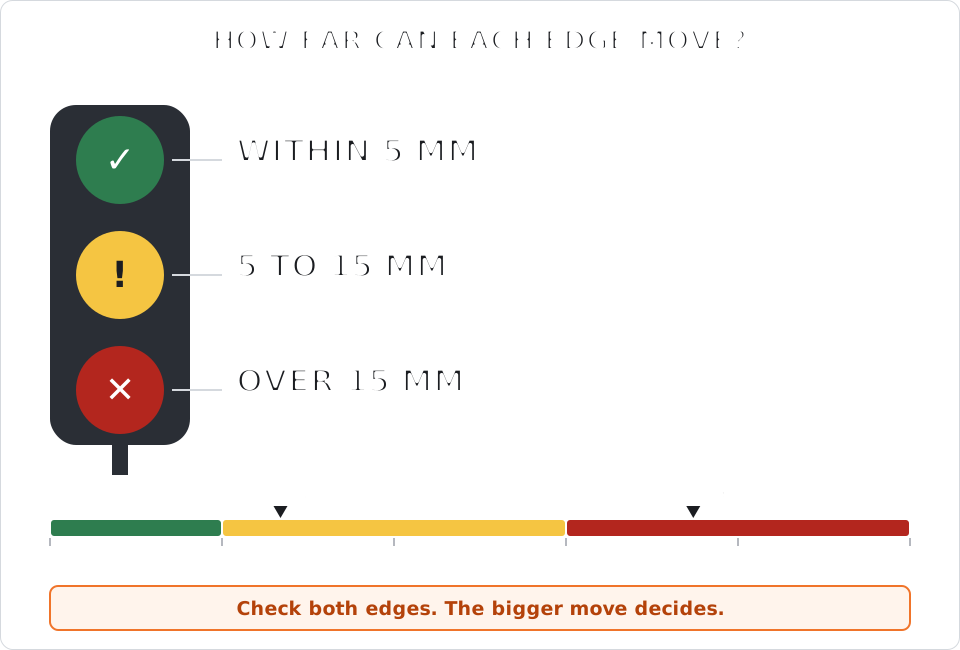
By that rule, the GTI example needs a look on both sides. The inner lip moves 6.7 mm, so check the strut. The outer lip moves 18.7 mm, so check the fender lip carefully before you buy.
For same-width wheels, AmericanTrucks keeps it simpler: if you don't want to change the stance, stay within 5 mm of stock offset.
Owners on forums report running about 7 to 11 mm below stock without rubbing at stock ride height (CivicX, Audizine). One Audi A3 owner asked about +35 wheels on a car that came with +46. He was told they should fit at stock height, with lowering and camber the things to watch. Camber is how far the wheel tilts in or out at the top.
On a car with tight strut clearance, drop the offset by the full 12.7 mm per extra inch of width. That keeps the inner lip where it was. All the extra width goes outward instead.
What offset changes besides the look
Offset also changes how the car steers and how hard the suspension works. Lower offset widens the track, the distance between the left and right wheels. That means less weight shifts across the car in corners. It also puts more load on suspension arms, ball joints, bushings and wheel bearings (HP Academy).
Offset moves the scrub radius too. That's the gap at road level between the tire's center and the point it steers around. Chassis engineer Huibert Mees gives an example. Move a wheel 50 mm outward and a 15 mm scrub radius becomes 65 mm. The wheel's load then presses outside the wheel bearing, so the bearing wears out sooner (The Autopian).
A bigger scrub radius gives more feedback and more shock load through the steering (Shock Therapy). It isn't always as simple as "lower offset, more scrub", though. It depends on where the car starts. Big offset changes also make tramlining more likely (Tire Rack). Tramlining is when the car follows ruts and grooves in the road.
Brake clearance is a separate question. Diameter and offset alone don't tell you whether the spokes clear the calipers. Spoke design, curvature, pad height and barrel profile all matter (Konig). If you run a big brake kit, use the wheel maker's brake template.
Bolt pattern and center bore have to work too. A GTI has a 5x112 bolt pattern, meaning five studs on a 112 mm circle. Its center bore, the hole in the middle of the wheel, is 57.1 mm. Most aftermarket wheels have a bigger bore and are lug-centric, meaning the lug nuts center them (Discount Tire). Hub-centric rings fill the gap. They center the wheel but don't carry its load.
Spacers are just offset you bolt on
A 10 mm spacer does the same job as 10 mm less offset (KSP, The Autopian). The fitment math above works the same way.
Use hub-centric spacers and keep enough thread on the studs. McGard says thread engagement should be at least equal to the stud diameter, so 12 mm on an M12 stud. With lug bolts, it says at least 5½ full turns into the hub. Our guide on whether wheel spacers are safe covers the rest.
Check the law where you live. Pennsylvania's inspection rules fail a car with spacers over 1/4 inch used to widen the track. They also fail tread that sticks out past the fender or flare (67 Pa. Code § 175.80). In Great Britain, "a tyre fouling a part of the vehicle" is a major MOT defect (GOV.UK). UK insurers also expect you to declare non-standard wheels (SimplyQuote). More on poke and the law in our piece on whether widebody kits are legal.
Stock offsets for popular cars
Most of the cars below sit between +40 and +60. Your trim's wheels may differ, so check the stamp on your own wheel before you order.
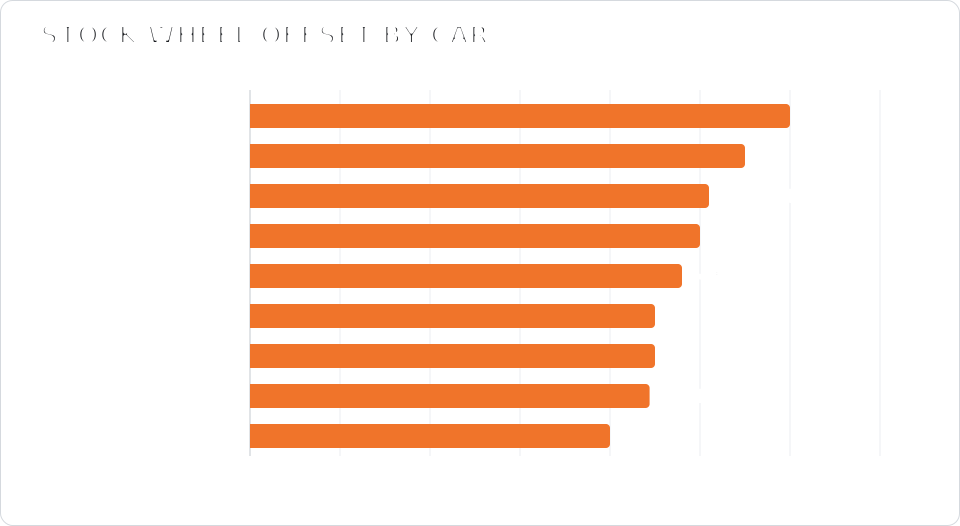
Car | Stock wheel | Offset | Bolt pattern | Center bore |
Mazda MX-5 ND (2016+) | 16x6.5 or 17x7 | +45 | 4x100 | 54.1 mm |
Toyota GR86 / Subaru BRZ (2022+) | 17x7.5 or 18x7.5 | +48 | 5x100 | 56.1 mm |
Honda Civic 11th gen (2022+) | 18x8 | +50 | 5x114.3 | 64.1 mm |
VW GTI MK7/7.5 (2018–2021) | 17x7.5 or 18x7.5 | +49 or +51 | 5x112 | 57.1 mm |
Ford Mustang GT S550, Ford Performance set | 19x9 front, 19x9.5 rear | +45 front, +52.5 rear | 5x114.3 | 70.5 mm |
Subaru WRX (2022+) | 18x8.5 | +55 | 5x114.3 | 56 mm |
Tesla Model 3 (2023+, 18-inch) | 18x8.5 | +40 | 5x114.3 | 64.1 mm |
Jeep Wrangler JL (2018–2021) | 17x7.5 | +44.4 | 5x127 | 71.5 mm |
Toyota Tacoma (2024) | 17-inch | +60 | 6x139.7 | 95.1 mm |
Each offset links to its source. Where a bore size came from a different page, it has its own link. The Mustang row is Ford Performance's accessory wheel set for 2015–2023 cars, not every factory wheel. Some trims differ: the GR86 10th Anniversary wheel is 18x8 +40, and Civic trims run +45 to +50. We couldn't confirm the stock 2024 Tacoma width, so it's left out.
What it costs to change offset
The wheels are the big cost. Each extra below runs from about $13 to $250, and they add up.
Item | Typical US price | What moves the price | Source |
Hub-centric spacers, pair | $63–$108 (H&R, 3–15 mm) | Thickness, bolt-on vs slip-on, brand | MAK, Turner |
Hub-centric rings, set of 4 | $13–$31 | Plastic vs aluminum | Walmart, SubiSpeed, Konig |
Fender rolling | $80–$99 per fender | Number of fenders, rolling vs pulling, paint condition | VAC, Streamline |
Mount and balance | $15–$45 per tire | Low-profile or run-flat tires, road-force balancing | Jerry |
Wheel alignment | $70–$130 front, $120–$250 four-wheel | Lowered or lifted car, camber kits | Jerry |
If you've also lowered the car, budget for an alignment. Our wheel alignment cost guide has more detail. A new vibration after fitting wheels often comes down to missing hub rings or balance. Our guide to why a car shakes at 70 mph walks through it.
What to do today
- Find your stock wheel size and offset on the back of a spoke or inside the rim.
- Write down the new wheel's width and offset, then work out the outer and inner change with the two formulas above.
- Measure your spare room: from the inner lip to the strut or spring, and from the tire to the fender lip. Check again at full steering lock.
- Match the bolt pattern and center bore, and order hub-centric rings if the new wheels are lug-centric.
- After fitting, torque the lug nuts to spec and re-check them after the first 25 miles, as McGard advises.
For how offset plays into the flush and poke look, see our explainer on stance, fitment and camber.
Sources are linked in the text. Main references: Tire Rack, Wheel-Size.com, TireWheelGuide and HP Academy.


No comments yet