
Yes, for most owners switching to regular tires makes sense, as long as you carry a way to deal with a flat. Regular tires cost less, usually come with a longer treadwear warranty and ride a little softer.
The trade is convenience. A run-flat lets you keep driving after a puncture, typically up to 50 miles at up to 50 mph. A regular tire leaves you on the shoulder with a sealant kit or a spare.
What a run-flat does
A run-flat has stiff, reinforced sidewalls that hold the car up when the air is gone. Tire Rack says those sidewalls "temporarily support the weight of the vehicle" at low or zero pressure (Tire Rack). A regular tire's sidewall can't do that.
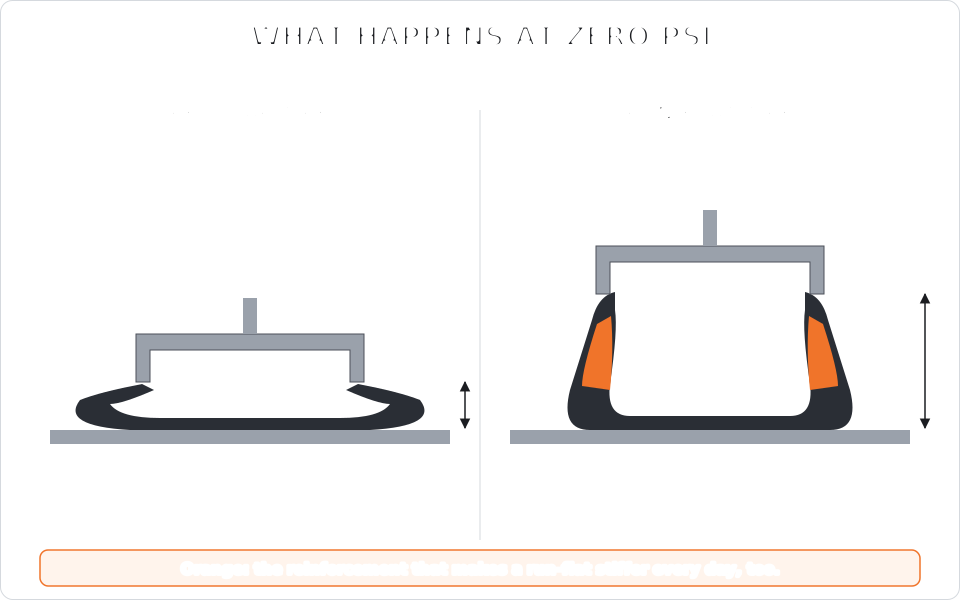
Tire Rack puts the limits plainly. Run-flats "cannot be driven faster than 50 miles per hour and typically offer up to 50 miles of extended mobility." They may only be used on cars with a tire pressure monitoring system (TPMS) that warns when a tire has lost 25% of its pressure. Without that warning, you might not notice a run-flat is flat.
BMW marks its approved run-flats RSC, short for Runflat System Component. The letters sit in a circle about 20 mm across on the sidewall (BMW Group).
What BMW says
BMW's own run-flat information sheet sets a maximum of 80 km/h (about 50 mph) on a flat tire. How far you can go depends on the load (BMW Group):
Load | Range on a fully flat run-flat |
|---|---|
Driver only | More than 150 km (about 93 miles) |
Fully loaded sedan | About 20 to 30 km (about 12 to 19 miles) |
That's a German-language BMW Group document dated May 2012. It says standard tires can be fitted in place of run-flats in an emergency. Some models could also be ordered with a spare wheel as an extra-cost option. In the US, BMW has fitted its TPMS (called RDC) as standard since late 2008.
Older guidance was stricter. A technician feature posted in 2007 went further, telling readers to never replace a run-flat with a conventional tire (TechDrive). We couldn't open a current US owner's manual page to confirm BMW's position today. Check the tire section of your own manual, which covers your exact car.
Ride, noise and handling
The difference is smaller than forum stories suggest, but it's real. In 2011, Tire Rack tested the same Bridgestone tire in run-flat and regular form on a BMW 328i, both in 225/45R17 (Tire Rack).
Measure | Run-flat (Potenza RE960AS Pole Position RFT) | Regular (Potenza RE960AS Pole Position) |
|---|---|---|
Ride | Very similar, small advantage to the regular tire | Slightly better |
Impact noise | Very close behind | Slightly less |
Steering response | A little crisper | A little slower |
Wet traction | Minor disadvantage | Minor advantage |
Fuel economy in test | 26.3 mpg | 26.7 mpg |
The run-flat used about 1.5% more fuel, roughly 8.5 gallons a year over 15,000 miles. Tire Rack's verdict was that testers felt "very little trade-off in everyday ride comfort and road manners."
Run-flats have moved on since 2011, and they vary a lot by design. In the same test, an older-generation Bridgestone run-flat "felt noticeably harsher" over sharp bumps. In 2014, Tire Rack still described the run-flat trade-off as "increased ride harshness" from the reinforced sidewalls (Tire Rack).
Kelley Blue Book also says run-flats ride rougher and wear out faster. Citing Consumer Reports, it says they need replacing roughly 6,000 miles sooner.
One more number from Tire Rack's 2011 test. With one run-flat at zero pressure, the car took about 10 feet longer to stop from 50 mph than with all four inflated. It pulled to one side but stayed controllable.
What it costs
Run-flats cost more to buy, and they often come with a shorter warranty. Kelley Blue Book puts the premium at 25% to 100% over regular tires.
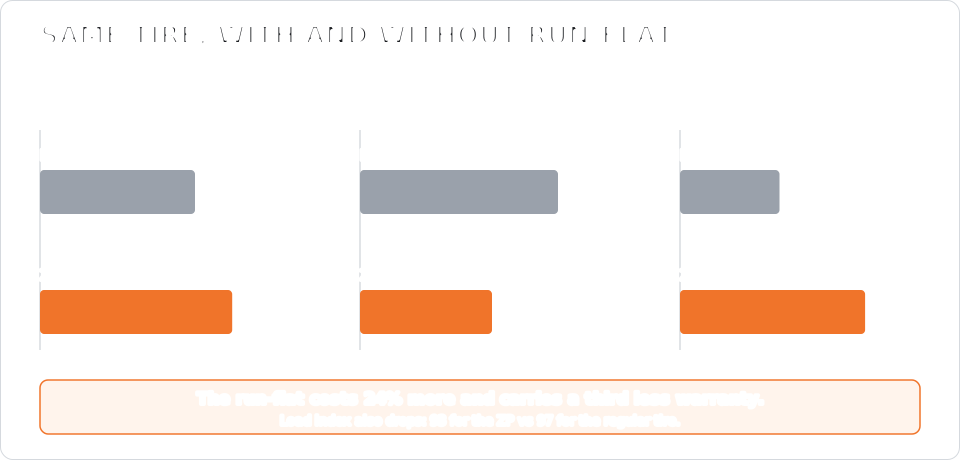
Here's one tire sold both ways in a common BMW size, 245/40R18, at Tire Rack:
Pilot Sport All Season 4 | Pilot Sport All Season 4 ZP (run-flat) | |
|---|---|---|
Price per tire | ||
Set of four | $915.96 | $1,135.96 |
Load and speed | ||
Treadwear warranty | ||
Cost per 1,000 warranted miles | $20.35 | $37.87 |
Prices checked in October 2026. The ZP set costs $220 more. Both warranties are halved for the rear tires when the rear size differs from the front, which is common on BMWs.
Check load index when you switch. If your car calls for a 93, a 97 is fine. Never go lower than the door label.
Fitting costs a bit more too. Shops often add $5 to $15 per tire for low-profile or run-flat tires (Jerry). Our guide to what new tires cost has the full list of fees.
Can a run-flat be repaired?
Sometimes, but many shops won't. Tire Rack won't repair any run-flat that's been driven at very low or zero pressure, because that can damage the tire's inner structure (Tire Rack). Makers' rules differ:
Brand | Run-flat repair policy |
|---|---|
Bridgestone | Permitted only if 15 psi was maintained |
Michelin | Permitted, one repair maximum |
Goodyear | Permitted, one repair maximum for H-rated and above |
Dunlop | Permitted, one repair maximum for H-rated and above |
Pirelli | Not endorsed; covered by its road hazard program |
Continental | Not recommended; a repair voids its other warranties |
Source: Tire Rack.
So a run-flat puncture often ends in a new tire. Often it's a pair, since Kelley Blue Book advises replacing the other tire on the same axle too. A regular tire with a nail in the tread is usually repairable. Our guide on driving with a nail in your tire covers when that's safe.
What you need if you drop run-flats
Cars on run-flats usually come without a spare, jack or lug wrench. Kelley Blue Book notes that saves weight and helps fuel economy. If you switch, you need to bring back a way to handle a flat.
Option | What it costs | What to know |
|---|---|---|
BMW M Mobility Kit (compressor and sealant) | $165.80 at BimmerWorld | Designed for cars without a spare, part 71105A34B40 |
BMW Tire Repair Kit Plus | Rechargeable, sealant lasts 6 years, fits 5x112 wheels only | |
Spare wheel | Varies by model | BMW offered one as an option on some RSC models. Needs space, a jack and a wrench |
Keep TPMS working. On regular tires it's your only early warning of a slow leak. Running a tire low does its own damage, as our guide on driving with low tire pressure explains. If you carry a spare, check its date code and its limits, covered in how long you can drive on a spare.
Should you switch? A quick guide
Keep run-flats if | Switch to regular tires if |
|---|---|
You drive long, empty roads or at night alone | You mostly drive in town or on busy highways |
You'd never change a tire or use a sealant kit | You're happy to use an inflator kit or call roadside help |
You want the car exactly as BMW delivered it | You want a softer ride and cheaper tires |
If you're buying a used BMW, ask what tires it's on and whether a kit came with it. Our guide to buying a used BMW has the rest of the checklist.
What to do today
- Check your sidewalls for the RSC mark or a run-flat code like ZP, RFT or SSR, so you know what you have.
- Look in the trunk for a spare, jack or inflator kit. If there's nothing, buy a kit before you switch.
- Read the tire section of your owner's manual for BMW's limits on your exact car.
- Price the same tire in run-flat and regular form in your size, and compare the treadwear warranties.
- When the new tires go on, make sure the shop checks the TPMS. If you're shopping for a summer tire, see our comparison of the Pilot Sport 4S and Pilot Sport 5.
Sources are linked in the text. Main references: Tire Rack run-flat guide, Tire Rack run-flat test, BMW Group and Kelley Blue Book.
Featured image: BMW i3 Wheel Close Up Car Leasing Made Simple by Carleasingmadesimpletm, CC BY 2.0. Source


No comments yet