
Flow formed wheels are the best value for most street and track-day cars. Forged wheels are lighter and can be stronger, but in the same size the gap was only 1 to 2.4 lb per wheel. In the two same-size pairs we could price, that cost $275 to $360 more per wheel.
Cast wheels cost the least and weigh the most. Speed Academy puts flow formed at "typically about 25% lighter than a cast wheel of the same size and specs" (Speed Academy). The bigger risk with a budget cast wheel is an unknown load rating, not the weight.
We may earn a commission from links here. It doesn't change what we recommend.
How each is made
The difference is how much of the wheel gets worked after the metal is shaped.
- Cast: molten aluminum is poured into a mold (gravity cast) or pushed into the bottom of a pressurized mold (low-pressure cast). Speed Academy says the two "don't differ much in terms of tensile strength or grain structure" in modern plants.
- Flow formed: the face is cast with a narrow barrel. The wheel is then spun while steel rollers press the barrel to its final width. Speed Academy says this gives "similar properties to a forged wheel in the barrel area."
- Forged: a solid aluminum forging is pressed into shape, then machined. Apex says its forgings are 6061-T6, pressed with 10,000 metric tons of force, and "weigh as much as 120 pounds before machining" (Apex).
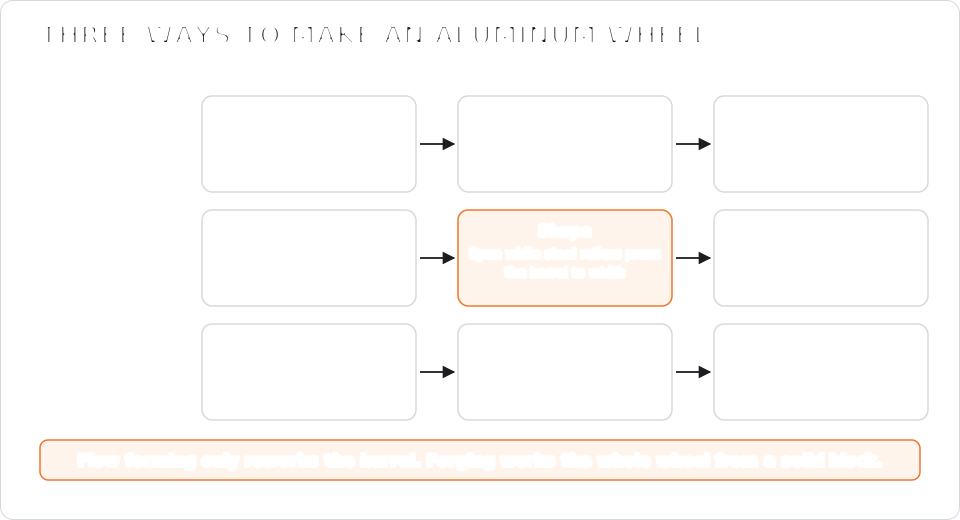
Listings name it differently. ThreePiece lists the Enkei RPF1 as "Flowform" (ThreePiece). Either way, a flow formed wheel is a cast wheel with a reworked barrel, not a forging.
Weight: forged saves 1 to 2.4 lb in the same size
Compare the same size or the numbers mean nothing. Here are four same-size pairs with a published weight for both.
Size | Flow formed | Forged | Difference |
|---|---|---|---|
15x9 | Konig Dial-In, 12.7 lb | Volk TE37V, "about 1 lb less" | About 1 lb |
17x9 5x100 | Konig Dekagram +40, 17.37 lb | Apex VS-5RS ET48, about 16.4 lb | 0.97 lb |
18x9.5 | Enkei GTC01RR, 20.3 lb | Volk TE37SL, "about 2 lb less" | About 2 lb |
18x10 ET25 5x120 | Apex SM-10, 21 lb | Apex SM-10RS, 18.6 lb | 2.4 lb |
The 15x9 and 18x9.5 figures are from Speed Academy, which doesn't say how they were weighed. The others are the makers' listed weights, October 14, 2026; Apex lists the VS-5RS as "~16.4 lbs."
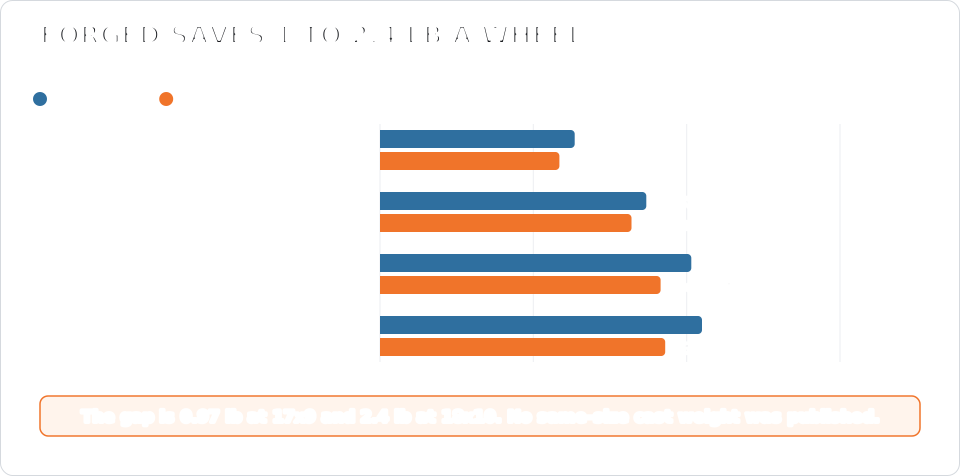
The Apex pair is the cleanest test, because it's the same design in both builds. Forged isn't automatically lighter, though. Apex's comparison table, all at 18x10 ET25 5x120 and dated May 16, 2025, lists its forged Enduro line at 21.1 to 21.7 lb, heavier than its flow formed Evolution line at 20.8 to 21.0 lb. The Enduro carries a 2,100 lb load rating against 1,550 to 1,600 lb (Apex). Forging buys strength, and a maker can spend it on weight or on load capacity.
For cast, we found no maker-listed weight in any of these sizes. Speed Academy says a typical eBay cast wheel weighs "more like 15- to 17-lbs each," without giving the size.
Does 1 to 2 lb a wheel matter?
On the street, barely. The one recent test we found used far bigger steps. Tyre Reviews' Jonathan Benson ran an F80 BMW M3 on wheels of 20, 38 and 52 lb each (Jalopnik).
Wheel weight | 31–87 mph | Lap time |
|---|---|---|
20 lb | 5.76 s | 99.13 s |
38 lb | 5.93 s | 99.92 s |
52 lb | 6.07 s | 100.74 s |
20 lb plus 130 lb ballast | 5.88 s | Not given |
An 18 lb jump per wheel cost 0.79 s a lap. Benson's verdict was that lighter wheels "won't make much of a performance difference if you're only driving on the street," though he could feel it in the steering.
An older Grassroots Motorsports test on a 1992 Miata, from its May 2014 issue, put about 11 lb more on each heavy corner (including a half-inch spacer). That set was 0.43 s slower to 60 mph, and the magazine's ballast run pinned about 0.29 s of it on the weight sitting at the wheels (Grassroots Motorsports).
The flow formed to forged gap of 1 to 2.4 lb is far smaller than either step. Neither test measured anything that small, so we won't scale their numbers down. Speed Academy's point is where the weight sits: flow forming trims the barrel, the part furthest from the hub, "where mass reduction has the greatest effect."
Strength, load ratings and the stamps
Flow forming makes a stronger barrel than casting. Speed Academy says it gives "a wheel capable of handling significantly higher loads than a cast wheel, all other design elements being equal," and better elongation. Konig says the end result of its flow forming "is stronger, lighter and offers greater elongation and shock resistance than a traditional cast design" (Konig).
The number to ask for is the load rating for your exact size. Apex lists 1,550 lb for the 18x10 SM-10 and 1,600 lb for the 18x10 SM-10RS. The 17x9 VS-5RS spec table says 1,500 lb, while the same page's line tables say 1,600 lb for the 18x10 fitment, so ask Apex for your size. Konig's Dekagram page leaves the load rating blank.
JWL is self-certified; VIA is third party
JWL is Japan's technical standard for passenger-car aluminum wheels, and JWL-T covers commercial vehicles. Work Wheels, a Japanese maker, calls the JWL test "a so-called self-certified treatment" done "at the manufacturer's own risk" (Work Wheels). Apex agrees that JWL "allows a manufacturer to conduct all these tests on its own with no third-party oversight" (Apex).
VIA is the check. Work says the VIA mark goes "only on the wheel that has completed the verification test and registered VIA," and the mark is a registered trademark of the Japan Vehicle Inspection Association.
One US brand says the opposite. Velgen's guide says "JWL mandates manufacturers to have their wheels inspected and approved by a certified Third-Party lab" (Velgen). We'd go with Work, a Japanese maker describing its own system.
SAE J2530: the aftermarket wheel standard
SAE J2530 covers "aftermarket wheels intended for normal highway use on passenger cars, light trucks, and multipurpose passenger vehicles." It sets performance, sampling, certifying, test and marking requirements (SAE). It was issued in March 2004, and SAE's page lists a December 2024 revision (J2530_202412) as the latest. Velgen lists the tests as radial fatigue, cornering fatigue, impact and torsion.
Read the wording, not the logo
Wheel | What the seller says | What it tells you |
|---|---|---|
Apex SM-10 (flow formed) | "Tested By: VIA," reference VIA-22-1501 | Third-party test with a number you can quote |
Apex VS-5RS (forged) | Tested by STL, reference STL-AX2-0004, "far above JWL standards" | Independent lab test; not a VIA registration |
Titan7 T-S5 (forged) | "Durability tested according to DOT/SAE and JWL/VIA standards" (Rallysport Direct) | Tested to the standards, which isn't the same as certified |
Konig Dekagram (flow formed) | No JWL, VIA or SAE statement; load rating blank | Ask Konig before you track it |
Price per wheel in October 2026
Flow formed ran $299 to $444 a wheel. Forged started at $540 and reached $1,087.
Wheel | Size | Build | Price per wheel | Set of four |
|---|---|---|---|---|
Budget cast, unbranded | Varies | Cast | $60–$100 (Speed Academy, undated) | $240–$400 |
17x9 +40 | Flow formed | $299.30 | $1,197.20 | |
17x9 +45 | Flow formed | $339.30 | $1,357.20 | |
18x9.5 ET35 | Flow formed | $444.00 | $1,776.00 | |
18x9.5 +40 | Forged | $540.00 sale ($655 before) | $2,160.00 | |
17x9 ET48 | Forged | $659.00 | $2,636.00 | |
18x9.5 ET22 | Forged | $719.00 | $2,876.00 | |
18x9.5 +43 | Forged | $1,086.54 | $4,346.16 |
Prices from the linked pages on October 14, 2026. Sets are four times the wheel price. The Titan7 showed as sold out and special order, shipping "from manufacturer when available." The Volk is made to order, and its page lists three conflicting lead times from 6–8 to 16–24 weeks, so confirm with the seller.
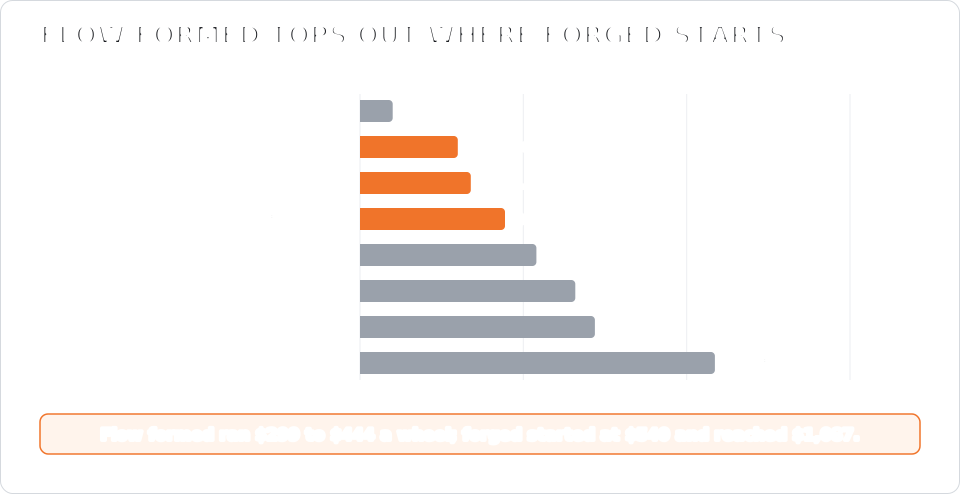
Now divide by the weight saved. Apex's same-design pair at 18x10 costs $454 against $729, so $275 a wheel, or $1,100 a set, for 2.4 lb. The Konig to Apex VS-5RS step at 17x9 is $359.70 a wheel for 0.97 lb. For specific GR86 fitments, see our best wheels for a GR86 picks.
Which one makes sense
Match the build to how hard you use the car.
Use | Build | Why |
|---|---|---|
Daily driver, budget | OE or branded flow formed | Known load rating; light enough |
Street plus track days or autocross | Flow formed with a listed load rating and test number | Most of the strength and weight benefit for about half the forged price |
Racing, or a heavy car on big wheels | Forged | Lowest weight, or the highest load rating, in the same size |
A specific design, such as a TE37 | Forged | Some designs only come forged |
Track use on unbranded cast | Avoid | Speed Academy warns they "may not have the strength or the load rating" for repeated track use |
Whichever you choose, get the fitment right first. Run the size and offset through the wheel offset calculator, and read our guide to whether wheel spacers are safe if a wheel needs one.
How to check this on your own car
The site hasn't tested these wheels. Here's how to check what you have or what arrives:
- Weigh each wheel. Stand on a bathroom scale holding it, then subtract your own weight, and note the size.
- Photograph the back of the spokes and the barrel. Look for JWL, VIA, SAE J2530, the load rating, the part number and the size and offset.
- Ask the seller for the test reference for your exact size, like Apex's VIA-22-1501.
- Compare the load rating with the one for your current wheel, and ask the maker if it isn't listed.
What to do today
- Decide your use: street only, street plus track days, or racing.
- Shortlist wheels in your exact size that publish a weight and a load rating.
- Price the same size in flow formed and forged, then divide the price gap by the pounds saved.
- Check offset and brake clearance before you order.
- Weigh and photograph the wheels when they arrive, before tires go on.
Common questions
Is flow formed as strong as forged?
In the barrel it's close: Speed Academy says flow forming gives the barrel "similar properties to a forged wheel." The face and spokes are still cast. Load ratings vary by design, so compare the rating for your size. At 18x10 ET25, Apex's flow formed SM-10 is rated 1,550 lb against 1,600 lb for the forged SM-10RS.
Are flow formed wheels worth it over cast?
For a car that sees track days, yes. Speed Academy puts flow formed at about 25% lighter than an equivalent cast wheel and much stronger, at $299 to $444 a wheel for the examples here. For a daily driver, a branded cast wheel with a published load rating is fine.
Is JWL a real certification?
It's a real Japanese standard, but the maker certifies itself. Work Wheels calls it "self-certified." Look for a VIA mark or a third-party test reference if you want an independent check.
Sources are linked in the text. Main references: Speed Academy, Apex SM-10RS, Work Wheels and SAE J2530.
Featured image: Alcoa alloy wheel 001 by Tennen-Gas (BY-SA). Source


No comments yet