
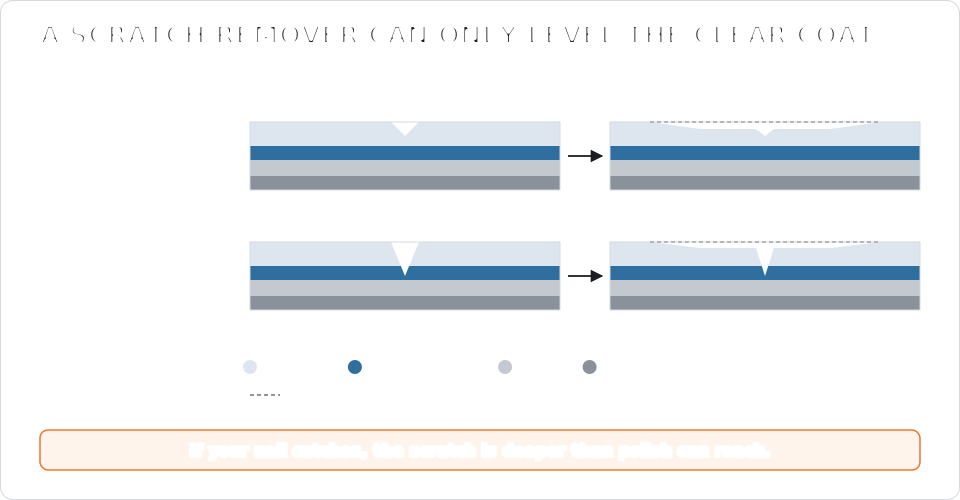
Yes, on light scratches that haven't gone through the clear coat. They don't work on scratches your fingernail catches in, because those have cut into the color layer and there's nothing left to polish level.
A scratch remover is a mild abrasive that rubs the clear coat level around the groove. For shop prices by depth, see our guide to what it costs to fix a scratch on a car.
What a scratch remover actually does
It levels the paint rather than filling it. Meguiar's describes ScratchX as using diminishing abrasives that cut at first, then break down and polish, and its own how-to says a scratch rarely comes out in one application. Its bird-dropping example took three.
There isn't much clear coat to work with. Detailer Mike Phillips puts factory clear at about 2 mils, thinner than a Post-it Note, and total factory paint at roughly 3 to 8 mils. Every pass with an abrasive takes some of that away.
Some products hide scratches instead. When Consumer Reports tested three fill-in products in 2014, including a Turtle Wax repair pen, they made scratches less visible head-on, but from the side they looked like a bad coat of clear nail polish.
Household fixes don't hold up either. Car and Driver's testers say WD-40, toothpaste or a Magic Eraser won't come close to a $20 kit. In a July 2026 test by UK consumer group Which?, WD-40 took four applications to make a noticeable difference and washed away with the first hand wash.
The fingernail test tells you if it will work
Drag a fingernail across the scratch at right angles. If it glides over, the damage is probably in the clear coat and a remover has a good chance.
If it catches, stop. Turtle Wax's own directions say a scratch that catches your nail "may be too deep for repair." Car and Driver's testers give the same rule, and so does AutoBodyShopNear.
What you see and feel | Layer reached | Does a remover work? | Better fix |
|---|---|---|---|
Swirls, haze, faint light marks | Top of the clear coat | Yes | Remover or fine polish |
Visible line, nail glides over | Clear coat | Often, with patience | Remover, then compound if needed |
Nail catches, same color as the car | Color (base) coat | No, it may fade a little | Touch-up paint or a body shop |
Gray line | Primer | No | Touch-up to seal, body shop to hide |
Shiny silver or bare plastic | Metal or plastic | No | Seal now, then body shop |
The Which? test found the same split. Some products faded medium scratches into the base coat, and none worked on deep scratches into primer or metal.
Compound vs polish vs scratch remover
They're all abrasives. The difference is how hard they cut. Mike Phillips ranks them simply: sanding removes paint, compounding removes paint, and polishing removes a little.
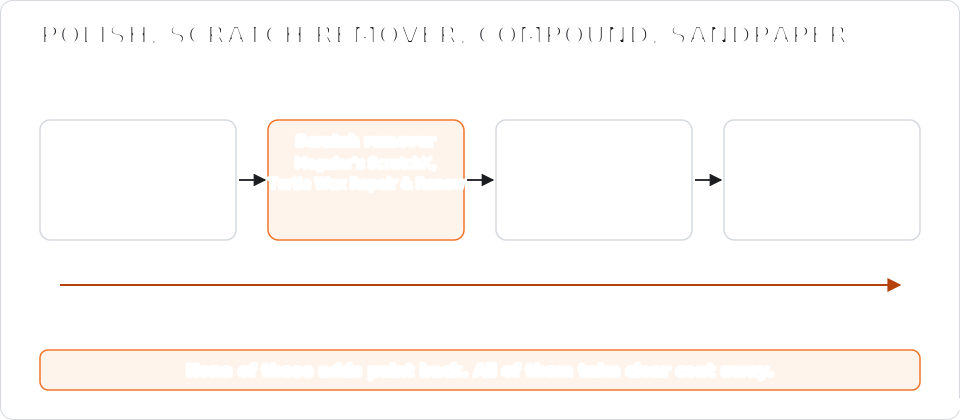
A polish is the finest. It takes out swirls and haze and brings back gloss. A scratch remover sits one step up and is made for isolated marks. A compound cuts faster again and is aimed at oxidation and heavier defects. Kits that start with sandpaper are the harshest, and they only make sense on a scratch that's still in the clear.
Start gentle. You can always make another pass, but you can't put clear coat back once you've rubbed through it, and Phillips notes that buffing through the clear shows up as a dull patch of exposed base coat.
Real products and what they claim
Here's what four common consumer products claim. None of the makers gives a depth limit in microns, so the fingernail test is still your guide.
We may earn a commission from links here. It doesn't change what we recommend.
Product | Type | How you apply it | Maker's claim |
|---|---|---|---|
Meguiar's ScratchX (G10307) | Fine scratch remover | Hand or dual-action polisher | Light scratches, blemishes, swirls |
Meguiar's Ultimate Compound (G17216) | Compound | Hand or dual-action polisher | Oxidation, scratches, water spots, blemishes |
Meguiar's Quik Scratch Eraser Kit (G190200) | ScratchX plus a 4-inch drill pad | Household drill at medium speed | Light scratches, scuffs, blemishes, paint transfer |
Turtle Wax Scratch Repair & Renew | Abrasive plus sealant | Hand or dual-action polisher | Light to heavy scratches, paint transfer, swirls |
Claims come from the makers' pages: ScratchX, Ultimate Compound, Quik Scratch Eraser Kit and Scratch Repair & Renew.
Meguiar's ScratchX is the one to try first on a single scratch by hand. Meguiar's says to work a 6 by 6 inch area or smaller and expect more than one application. The drawback is effort, and Car and Driver found the bottle a bit pricey next to the kit that includes it.
Meguiar's Ultimate Compound cuts harder, so keep it for marks ScratchX won't shift. Its product page says it's "formulated to be effective for hand use only" and also says it can go on with a dual-action polisher, which is confusing. Follow it with a polish to bring the gloss back.
Meguiar's Quik Scratch Eraser Kit is the drill-powered option. It was Car and Driver's best overall pick for effectiveness, ease of use and speed. You need a drill, and Meguiar's says it isn't for matte or satin paint.
Turtle Wax Scratch Repair & Renew adds a sealant, so it protects the spot as well as cutting it. In Car and Driver's test the scratch was still faintly visible afterward.
Car and Driver's 2022 test tried seven products on a light scratch on a Ram 1500 TRX, using three 30-second passes each. The drill kit and a wet-sanding kit did best, and Nu Finish Scratch Doctor did worst.
How much it costs to buff out a scratch
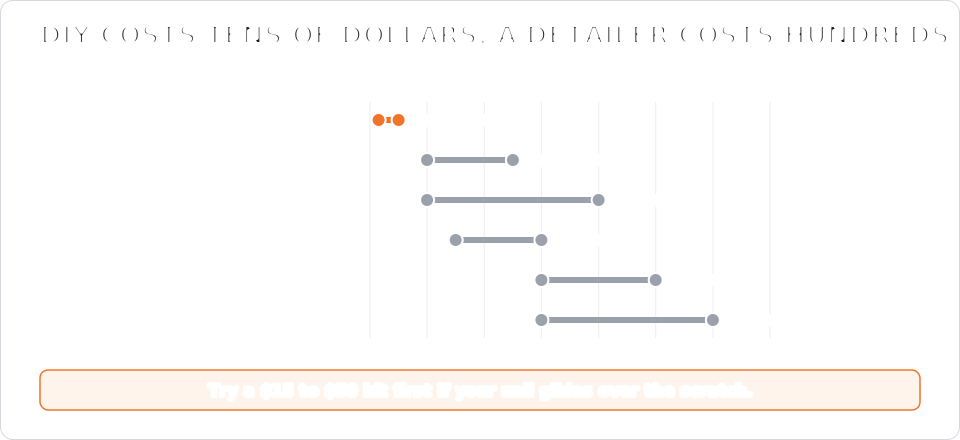
A pro charges about $100 to $300 to take out a clear-coat scratch, against $15 to $50 for a DIY kit. One New Jersey detailer posts up to $400 for a stubborn spot. The shop uses the same idea, wet sanding and machine polishing, with more skill and better tools.
Job | Price | Source |
|---|---|---|
DIY scratch remover kit | $15 to $50 | AutoBodyShopNear, 2026 |
DIY kit, surface scratches | $10 to $30 | Byers Collision, one shop in Gahanna, Ohio |
Pro wet sand and machine polish, per area | $100 to $250 | AutoBodyShopNear |
Spot correction or wet sanding, per repair | $100 to $400 | CDC Detailing, one shop in Pitman, NJ, Aug 2026 |
Clear-coat scratch repair at a body shop | $150 to $300 | AutoBodyShopNear; Byers Collision |
One-step polish, small car or coupe | $300 to $500 | CDC Detailing (same shop), Aug 2026 |
One-step polish, mid-size sedan | $350 to $600 | CDC Detailing (same shop), Aug 2026 |
Scratch into the color coat | $300 to $600 | AutoBodyShopNear |
What moves the price is how many scratches, how deep, and whether the detailer has to polish the whole panel to make the repair blend. If the car is covered in swirls as well, a one-step polish of the whole car can be better value than paying for spot work.
If your nail catches, the choice is touch-up paint or a body shop, not a remover. Our comparison of touch-up paint vs a body shop covers that decision. Keyed across several panels is a different job again, covered in why someone would key a car.
What to do today
- Wash and dry the panel, then do the fingernail test in good light.
- If your nail glides over it, try a light remover like ScratchX by hand on a 6 by 6 inch patch, a few applications, wiping off between rounds.
- If the scratch is fainter but still there, step up to a compound, then finish with a polish and wax.
- If your nail catches, stop rubbing. Order touch-up paint by the code on your door jamb sticker, or get a shop quote.
- If you'd rather not do it, ask a detailer for a spot-correction price with photos. Expect roughly $100 to $300, more for a stubborn spot.
Common questions
Do scratch removers work on deep scratches?
No. If your fingernail catches, the scratch has cut into the color coat or deeper. A remover may soften the edges, but Car and Driver's testers say anything deeper than the clear coat will probably need a professional. In the Which? test, no product worked on scratches into primer or metal.
How much does it cost to buff out a scratch?
About $100 to $250 per area for pro wet sanding and polishing, or $150 to $300 for a clear-coat scratch at a body shop (AutoBodyShopNear). One New Jersey detailer lists spot correction at $100 to $400 per repair.
Can a scratch remover damage my paint?
Yes, if you overdo it. Each pass removes clear coat, and factory clear is only about 2 mils thick. Rubbing hard at a deep scratch thins the clear around it and can leave a dull spot.
Does WD-40 remove car scratches?
Not really. Car and Driver's testers say it won't get results close to a $20 kit. In the Which? test it took four applications to make a noticeable difference and washed off with the first hand wash.
Sources
Sources are linked in the text. Main references: Car and Driver test via Yahoo Autos, Mike Phillips on clear coat thickness, AutoBodyShopNear and Meguiar's ScratchX how-to.
Featured image: Scratched painted surface - edited by Henry Söderlund, CC BY 2.0. Source


No comments yet