
The battery light means your car has stopped charging its battery. The usual culprit is the alternator or the belt that drives it, not the battery itself. You're now running on what's left in the battery, so go only as far as the nearest shop or a safe place to stop.
Switch off everything you don't need, and don't turn the engine off until you get there. It may not restart. If the lights dim, the temperature gauge climbs or the steering gets heavy, pull over and call a tow.
What the light is telling you
The light watches the charging system, not the battery's health. AAA puts it simply: the battery isn't being charged. Honda's owner's guide for the Clarity Plug-In Hybrid says the same thing in almost the same words (Honda). Volkswagen calls the same symbol an alternator malfunction (VW).
With the engine running, the alternator should power the car and top up the battery. When it stops, everything runs off the battery until the battery is flat. Then the engine stalls.
It's one of the red lights in our dashboard warning lights guide. A brief flash at startup is just the bulb check.
Causes, from most to least likely
A failing alternator is the most likely cause, according to Jalopnik. AAA puts a faulty alternator at the expensive end and a slipping belt at the cheap end. RepairPal adds bad battery connections, blown fuses and faulty wiring or voltage regulators.
Cause | Signs that point to it | Typical fix and cost |
|---|---|---|
Failing alternator | Dim or flickering lights, whining that changes with revs, accessories acting up | Alternator: $809 to $1,088 |
Loose, worn or broken belt | Squealing, especially at startup; harder steering or overheating if it snapped | Serpentine belt: $154 to $212 |
Loose or corroded battery terminals | Loose clamps, worn cables or corrosion on the posts | Clean and tighten |
Worn-out battery | Won't hold a charge even though the running voltage is normal | Battery: $120.51 to $189 at Walmart (listings below), or $456 to $493 fitted |
Blown fuse, bad wiring or regulator | Same fuse blows again, other electrical faults | Diagnosis first; if a fuse blows again, RepairPal says get to a mechanic right away |
The alternator signs come from O'Reilly Auto Parts, which also lists stalling and a battery that keeps going dead after driving. The belt signs come from O'Reilly's serpentine belt guide.
Don't skip the cheap checks. A battery or terminal problem can mimic a bad alternator, O'Reilly warns, so confirm the cause before you buy parts.
How long can you drive with the battery light on
Not far, and you can't know exactly how far. RepairPal says that depending on the cause and your battery's condition, you may have around half an hour, or you may have less, and less again at night. Jalopnik's estimate is 30 minutes to an hour, depending on the battery.
Treat those as an outside limit, not a target. AAA and Honda both say to get the car repaired immediately. Go only as far as the nearest shop, parts store or home if it's close. If it isn't, or it's dark, pull off somewhere safe and call a tow rather than risk the engine dying in traffic.
The battery's reserve capacity rating explains why the time varies. It's the number of minutes a battery can deliver 25 amps while staying above 10.5 volts (Rolls Battery). Battery maker Clarios puts it more plainly: it's how long a fully charged battery can run your vehicle if the alternator fails (Clarios). Three EverStart batteries listed at Walmart in October 2026 show typical figures:
Battery (Walmart listing) | Reserve capacity | Price, October 2026 |
|---|---|---|
100 minutes | $120.51 | |
130 minutes | $154.34 | |
140 minutes | $189.00 |

Those are best-case lab numbers for a new, full battery. Yours may be old or part-drained, and headlights, wipers and the blower fan all add load. That's why real-world estimates are half an hour or less, not two hours.
When to stop right away
Pull over as soon as it's safe and call for help if any of these happen:
- The headlights or dash dim. RepairPal says that means you're almost out of time.
- The car feels like it's about to die. Jalopnik's advice is to find a safe place to pull over as soon as possible.
- The temperature gauge climbs or the steering gets heavy. On many engines one serpentine belt drives the alternator, the water pump and the power steering pump, and O'Reilly says a failed belt can cut power to all of them and lead to overheating.
That last case risks the engine, not just the battery. Don't drive on.
Is it the battery or the alternator: the multimeter test
A cheap multimeter answers the question in a couple of minutes. Set it to DC volts and put the probes on the battery terminals, red to positive.
Reading | What it means | Source |
|---|---|---|
12.6 V, engine off | Battery fully charged | |
12.4 V, engine off | About 75% charged | Fluke |
12.2 V, engine off | About 50% charged | Fluke |
Under 12.0 V, engine off | Discharged or weak | Fluke |
Above 13.0 V, engine running | Charging voltage present | Fluke |
13.5 to 14.8 V, engine running | Charging system working | |
13.7 to 14.7 V, engine running | Good alternator, normal conditions | Fluke |
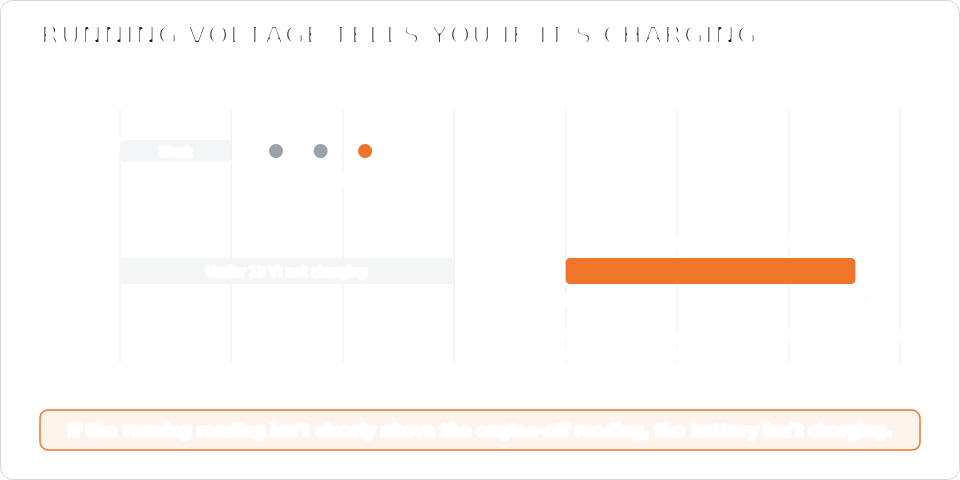
Read it with the engine off first, then running. If the running figure sits close to the engine-off figure, or under 13 volts, the alternator or belt is the problem. If it reaches 13.5 to 14.8 volts, O'Reilly's range, but the battery still won't hold a charge overnight, suspect the battery or a terminal.
You don't need a meter to get an answer, though. O'Reilly's store services page offers free battery, starter and alternator testing on or off the car, including a bench test of an alternator you've removed.
What the fix costs
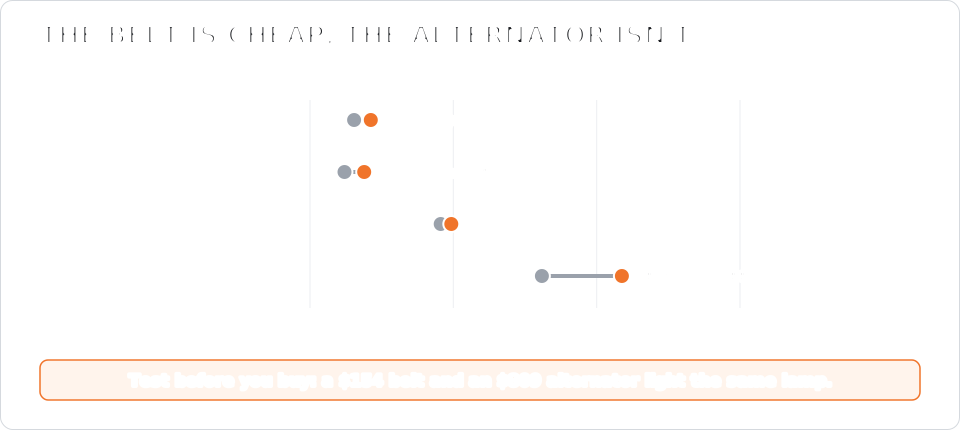
The belt is the cheap outcome and the alternator is the expensive one. RepairPal's estimates were updated September 3, 2026, and exclude taxes and fees.
Repair | Typical US cost | Source |
|---|---|---|
Serpentine belt, fitted | $154 to $212 | |
Battery, shelf price | $120.51 to $189 | Walmart listings above, October 2026 |
Battery, fitted | $456 to $493 | |
Alternator, fitted | $809 to $1,088 | |
Alternator, Toyota Camry | $566 to $876 | |
Alternator, Ford F-150 | $831 to $1,025 |
RepairPal's fitted battery estimate sits far above Walmart's shelf prices because it assumes $394 to $403 for the battery itself, plus $61 to $90 of labor. Its Camry figure, $1,045 to $1,064, runs past $1,000. Ask which battery a quote includes. O'Reilly's store services page says staff will install new batteries in many vehicles for free.
Alternator labor depends on access. RepairPal says some jobs need suspension parts, drive axles or a bumper removed. If your belt is worn, replace it while the alternator is out, since it has to come off anyway. Our guide on how to get a car repair quote covers what to ask before you approve the work.
What to do today
- Turn off the A/C or heat, stereo, heated seats and phone chargers. Honda's advice: "Turn off all electrical items, but do not turn off the vehicle to prevent further battery discharge."
- Watch the lights, the temperature gauge and the steering. If the lights dim, the gauge climbs or the steering gets heavy, pull over safely and call for a tow.
- Go only as far as the nearest shop, parts store or home, and don't stop the engine on the way. If none is close, or it's dark, stop somewhere safe and call a tow.
- Get the battery and alternator tested for free at an O'Reilly store, or check the voltage yourself: 13.5 to 14.8 volts with the engine running means it's charging.
- After an alternator or belt fix, have the battery recharged or tested too. Jalopnik advises recharging or replacing it once the alternator is fixed.
Common questions
Can I drive with the battery light on?
Only a short way, to the nearest shop or a safe place to stop. Keep the engine running and electrical loads off. Pull over and call a tow if the lights dim, the temperature gauge climbs or the steering goes heavy.
How long can you drive with the battery light on?
Around half an hour, or less, according to RepairPal. Jalopnik says 30 minutes to an hour. Night driving shortens it, because the headlights draw power from the battery. Don't plan a trip around those numbers; AAA says to get the car to a repair facility immediately.
Is it the battery or the alternator?
Usually the alternator or its belt. Test the voltage with the engine running: 13.5 to 14.8 volts means the alternator is charging, so look at the battery and terminals instead. O'Reilly stores will test both for free.
Why did my battery light come on and then go off?
O'Reilly says a charging light that flickers or stays on usually points to unstable system voltage, one of its signs of a failing alternator. RepairPal adds that a loose belt or a bad battery connection can trigger the light too. Get it tested before it stays on for good.
Sources
Sources are linked in the text. Main references: RepairPal, O'Reilly Auto Parts, Fluke and AAA.
Featured image: Walmart EverStart Car Batteries, Battery by JeepersMedia, CC BY 2.0. Source


No comments yet